AI Music Generation in 2026 Is Moving Faster Than Most Producers Can Keep Up
AI Music Industry Update.
The New Era of AI Music Generation Has Already Started
The AI music industry is no longer driven by simple “text-to-song” novelty. The newest trend dominating 2026 is full creative ecosystems where AI handles music generation, lyric writing, vocal synthesis, visual branding, metadata support, and content creation inside connected workflows.
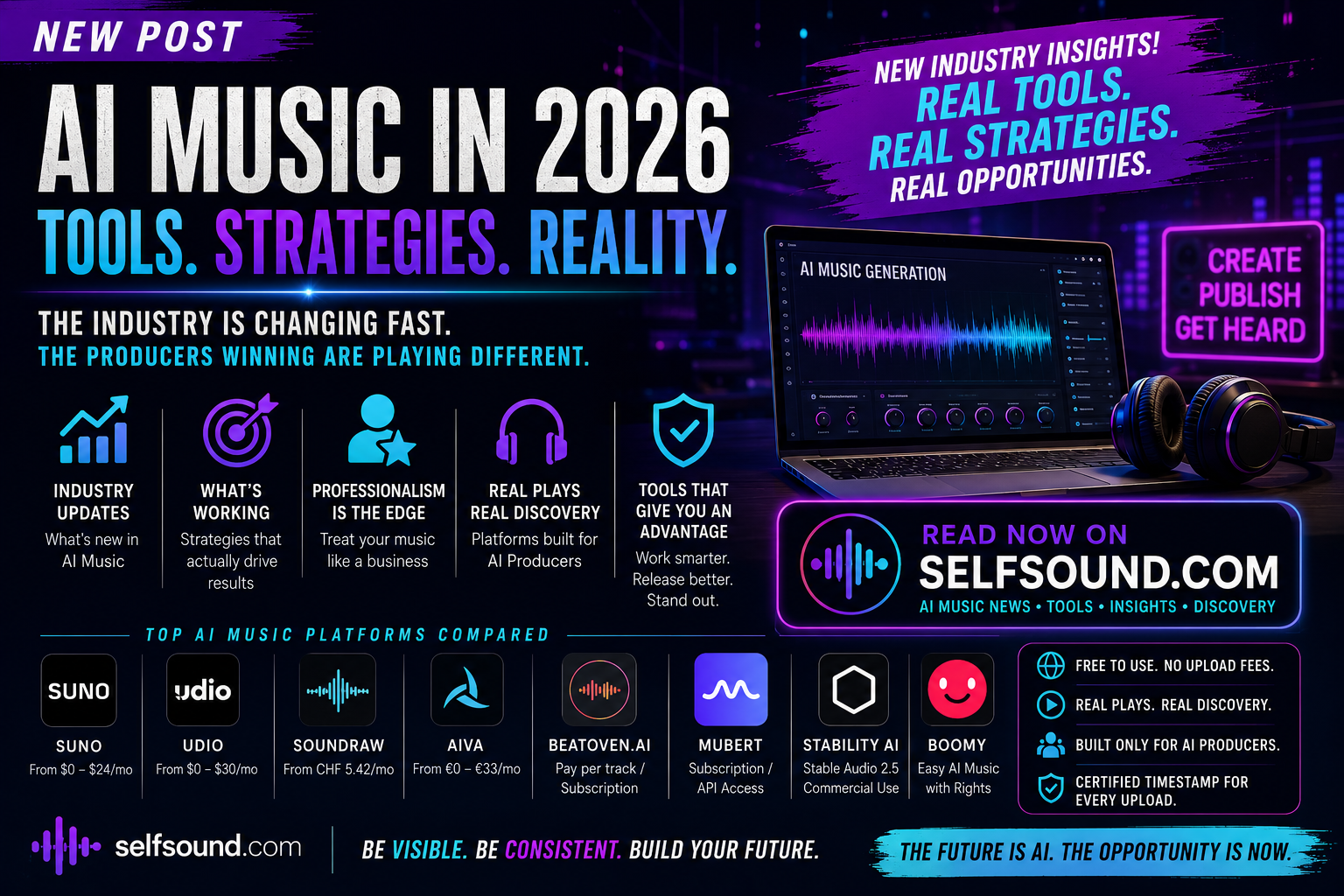
Suno v5.5 continues leading the mainstream AI music market because of its speed, realistic vocals, and improved personalisation systems. Producers can now train voice-influenced generation models, build stylistic memory into projects, and generate complete songs in under a minute. Udio has evolved into the preferred platform for creators who want more precision and arrangement control, especially in electronic music, cinematic production, and layered vocal editing. Google’s Lyria 3 has become one of the most important developments in the industry because it introduces multimodal music generation, allowing creators to generate songs from text prompts, visual references, mood concepts, and image-based direction.
The biggest trend emerging right now is cross-modal AI creation. Producers are no longer creating music separately from visuals. AI systems are increasingly generating entire creative packages simultaneously. A creator can now describe a mood, generate a soundtrack, create matching visuals, generate lyrics, produce cover artwork, and prepare social content within the same production cycle. This shift is changing how music is marketed and consumed online.
Another major trend is AI voice identity. Platforms like Kits.ai, AI Singer, and Suno’s newer voice systems are pushing hard into personalized vocal generation. Producers are increasingly building artist identities around AI-assisted voices, cloned vocal textures, and hybrid vocal production systems. The industry is moving toward customizable AI performers rather than anonymous generated vocals. ([AI Singer][3])
The rise of synthetic AI artists is now impossible to ignore. AI-generated acts are already charting, building audiences, and generating controversy across streaming platforms. The emergence of virtual AI artists like IngaRose proves that AI-generated identities are no longer experimental side projects. They are becoming commercial products with audiences, branding, social followings, and streaming momentum.
At the same time, the legal environment around AI music is tightening rapidly. The industry conversation has shifted away from pure lawsuits and toward licensing negotiations, attribution systems, and monetization control. Labels are increasingly moving toward licensing deals with AI companies while platforms work to improve ownership clarity and rights management systems. Producers entering AI music today need to understand that copyright, licensing, and metadata management are becoming just as important as creativity itself.
The producers gaining traction right now are not necessarily the most technically skilled musicians. They are the creators building complete content ecosystems around their music.
The biggest mistake many AI producers still make is treating music generation as the finish line. It is not. Generation is now the starting point.
Modern AI producers are using AI music as fuel for short-form content, cinematic clips, animated visuals, livestream loops, storytelling videos, TikTok edits, YouTube Shorts, Instagram Reels, and branded creator identities. The music becomes part of a much larger visibility strategy.
This is why AI video creators are moving aggressively into AI music production. They already understand audience retention, visual pacing, emotional sequencing, and algorithm behavior. AI music fits naturally into that workflow. A creator who understands how to make viral short-form visuals already has a massive advantage when pairing those visuals with AI-generated music.
Speed is also becoming one of the defining advantages in the industry. Producers capable of generating, refining, branding, and publishing quickly are outperforming creators who spend months obsessing over perfection. The platforms reward activity, consistency, and visibility. Momentum now matters more than isolated releases.
The smartest AI producers are also studying data aggressively. They monitor what genres perform well, what vocal styles create engagement, what video formats increase retention, and which emotional themes repeatedly generate listener response. AI music production has become deeply tied to trend analysis and audience psychology.
Research around AI-generated music is now even focusing on predictive popularity systems trained on engagement patterns, aesthetic analysis, and listener behavior. This means the platforms themselves are increasingly learning what kinds of AI music generate the strongest audience response.
One of the most important trends emerging in 2026 is real-time adaptive music generation.
The industry is moving toward AI systems capable of generating music dynamically for games, livestreams, VR experiences, social content, and interactive entertainment. Personalised AI DJs, adaptive mood playlists, live generative scoring, and reactive sound environments are becoming serious development areas rather than futuristic concepts.
This changes the role of the producer completely.
Instead of only creating static finished songs, producers are increasingly building systems, moods, textures, loops, stems, and adaptable music frameworks that AI can modify in real time. The next generation of AI music creators may operate more like creative directors than traditional musicians.
Another growing trend is mobile-first AI music creation. AI music apps are now becoming powerful enough to handle professional-level workflows directly from smartphones and tablets. Producers are increasingly building tracks, generating ideas, refining vocals, and publishing content entirely through mobile ecosystems.
This accessibility is rapidly expanding the creator economy around AI music. More creators are entering the space every day because the technical barriers are disappearing faster than ever before.
The AI music market is exploding, but attention is becoming harder to earn.
Millions of AI-generated tracks are flooding platforms constantly. Some streaming services now report tens of thousands of AI-generated uploads every single day. This means discoverability is becoming brutally competitive.
Most producers will fail because they focus entirely on generation while ignoring visibility.
Uploading music is not promotion.
Generating songs is not branding.
Posting randomly is not strategy.
The producers building actual audiences are operating consistently across multiple platforms. They are treating themselves like brands, not anonymous uploaders. They understand metadata, visuals, audience retention, release timing, social engagement, and platform behavior.
Professionalism is becoming one of the few remaining advantages in an overcrowded AI music environment.
One of the most important shifts happening right now is the rise of AI-first music platforms designed specifically for AI producers instead of traditional music ecosystems.
Selfsound.com is positioning itself directly inside this growing movement. Instead of treating AI-generated music like secondary content, the platform is building around AI producers themselves.
That matters because discoverability improves dramatically when your work exists inside a platform designed for AI creators rather than platforms resistant to AI-generated content.
Selfsound.com is increasingly becoming useful because it combines music discovery with practical creator tools. AI music producers need more than upload pages. They need systems that support metadata management, presentation quality, visibility, engagement, and consistent creator growth.
As AI music continues evolving, platforms built specifically around AI creators will likely become increasingly important for long-term discoverability and audience development.
The next phase of AI music generation will not belong to producers who simply know how to type prompts.
It will belong to creators who understand branding, visual identity, audience psychology, trend analysis, content ecosystems, licensing, metadata, and long-term consistency.
AI music generation is evolving into a complete media industry, not just a music tool category.
The creators who succeed moving forward will be the ones who adapt fastest, publish consistently, learn constantly, and treat AI music like a professional creative business instead of a temporary trend.
Because the industry is no longer asking whether AI music is real.
The industry is now deciding who survives inside it.
The New Era of AI Music Generation Has Already Started