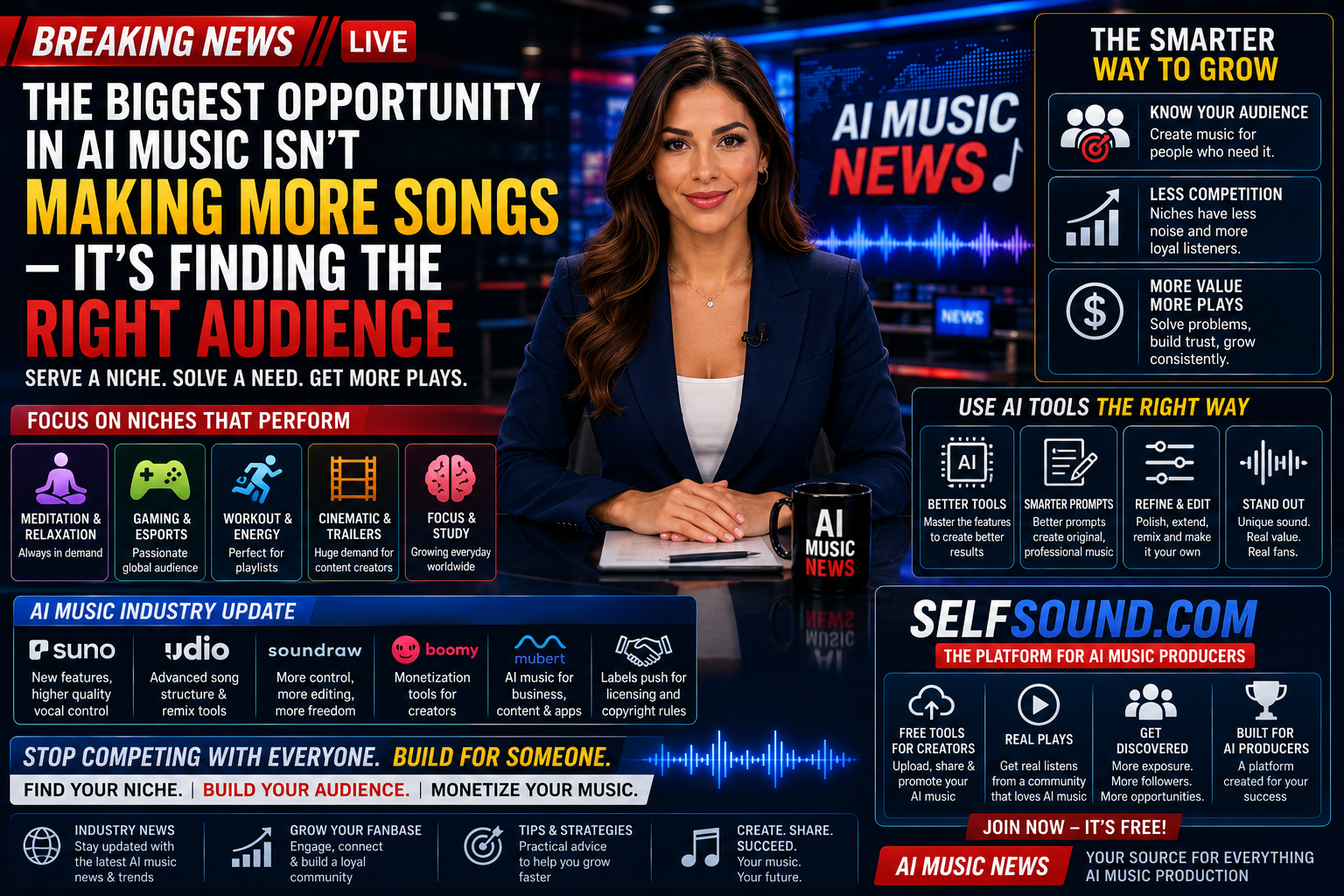
The AI music industry continues to grow at an extraordinary pace, with new creators entering the market every day and generating more music than ever before. Platforms such as Suno, Udio, Soundraw, Mubert, Boomy, Loudly, Beatoven, and other AI music services are constantly releasing new features designed to improve audio quality, increase creative control, and help producers create professional tracks faster.
The focus of many platforms is now shifting beyond simple music generation. Advanced editing tools, custom vocals, song extension features, remixing capabilities, stem exports, and improved commercial licensing options are becoming standard expectations. As competition increases, platforms are looking for ways to help creators not only make music but also build audiences and generate income.
Meanwhile, major music companies such as Universal Music Group and Warner Music Group continue pushing for stronger copyright protections and licensing agreements as AI music becomes a larger part of the industry. The technology is advancing rapidly, but so are the discussions surrounding ownership, distribution, and monetization.
Yet despite all the innovation, one challenge remains unchanged. There is now more music available than at any point in history. The question is no longer whether creators can make music. The question is whether they can find people who actually want to listen to it.
Many AI producers are still competing in the most crowded areas of the market. They create generic pop songs, generic electronic tracks, or generic cinematic music and then wonder why nobody notices.
The producers seeing real growth are often taking a different approach. Instead of chasing the largest audience, they focus on serving a specific audience exceptionally well.
Successful creators are building communities around niche genres, niche interests, and niche listener groups. They understand that it is far easier to become important within a small market than invisible within a large one.
Engagement continues to be one of the most powerful growth tools available. Producers who actively communicate with listeners, respond to comments, and build genuine relationships create loyalty that algorithms alone cannot provide.
Consistency remains critical. Audiences support creators who show up regularly. Visibility creates familiarity, and familiarity creates trust. The producers growing today are often those who remain active week after week while continuing to learn from other successful creators in their niche.
The smartest creators are constantly researching audience behavior. They are asking important questions. Who is listening? Why are they listening? What problem does this music solve? Understanding the audience often creates far greater opportunities than simply creating more tracks.
One of the hardest truths in AI music is that quality alone is rarely enough.
Many producers spend countless hours perfecting songs that nobody hears. They focus entirely on production while ignoring the audience. Unfortunately, the market does not reward effort. It rewards value.
Not everyone will succeed because most creators are still approaching AI music as a hobby while expecting professional results. They release tracks without a strategy, without promotion, and without any understanding of who their music is actually for.
The creators who are winning today are strategic. They know their audience. They understand their niche. They create content with a purpose rather than hoping random listeners will eventually discover them.
Many producers are trying to compete against millions of tracks on mainstream platforms. The smarter approach is often finding smaller markets where demand exists but competition remains manageable.
Success in AI music increasingly comes down to positioning rather than production alone.
Professional producers think differently about music creation.
Before they create a track, they often know exactly who the listener will be. They understand where the music will be used, how it will be discovered, and what audience it is intended to serve.
Metadata remains essential for discoverability. Proper descriptions, accurate genre classifications, optimized keywords, and professional presentation all increase the chances of reaching the right listeners.
Branding is equally important. Consistent visuals, artist identity, messaging, and release schedules create a professional image that audiences can trust.
Professional producers also understand the value of treating music as a business. They track results, analyze performance, identify successful content, and continuously refine their approach.
The difference between amateur and professional creators is often not talent. It is discipline, planning, and execution.
As AI music continues to evolve, dedicated AI music platforms are becoming increasingly important for creators looking to stand out from the crowd.
Selfsound.com is growing as a platform built specifically for AI music producers and creators who want more than simply another place to upload tracks. The platform provides free tools designed to help AI musicians showcase their work, gain visibility, and connect with audiences interested in AI-generated music.
For creators seeking real plays and meaningful exposure, Selfsound offers opportunities to reach listeners who are already engaged with AI music. Rather than competing for attention within massive music catalogs, producers can participate in a community focused on AI creativity.
Selfsound continues to develop as a platform where creators can build audiences, increase discoverability, and establish a stronger presence within the growing AI music ecosystem.
As AI music expands globally, platforms dedicated to AI creators may become some of the most valuable resources available for audience development and long-term growth.
The future of AI music may not belong to the producers creating the most songs. It may belong to the producers who understand their audience better than anyone else.
Every listener is looking for something. Relaxation music. Workout music. Fantasy soundtracks. Focus playlists. Meditation tracks. Background music for creators. Music for gaming communities. Music for specific cultures, hobbies, interests, and lifestyles.
The biggest opportunities often exist where fewer creators are looking.
Rather than asking how to make more music, producers should ask how to become more valuable to a specific audience. When music solves a problem, creates an experience, or serves a clear purpose, listeners return.
The AI music market will continue becoming more competitive. More creators will enter the industry. More tracks will be released. More platforms will emerge.
The producers who thrive will be those who stop chasing everyone and start serving someone. In a crowded marketplace, being relevant to a specific audience is often far more powerful than being available to everyone.
The future belongs to creators who understand that success in music is not just about creating tracks. It is about creating value for the people who listen to them.