One of the most common mistakes among AI music producers is starting with the technology instead of starting with the idea.
The platforms have become so powerful that many creators jump straight into generating songs without having any clear direction. They type a genre into Suno or Udio, generate multiple tracks, and hope something sounds good.
Sometimes it works.
Most of the time it creates music that sounds generic, forgettable, and disconnected from any real audience.
The producers generating the strongest AI music today are following a process.
Not a rigid formula.
A workflow.
The goal is not simply to create music. The goal is to create music that people remember.
Before writing lyrics.
Before choosing a genre.
Before opening any AI platform.
Ask one question.
What should the listener feel?
Emotion should always come first.
The strongest songs in history are built around emotional reactions. Love. Nostalgia. Loss. Hope. Excitement. Anger. Motivation. Escape.
Many AI creators focus on sounds.
Successful producers focus on feelings.
Once you know the emotional target, every other decision becomes easier.
Genre becomes easier.
Lyrics become easier.
Visual branding becomes easier.
Promotion becomes easier.
A song with a clear emotional purpose almost always performs better than a technically perfect song with no emotional direction.
This surprises many producers.
Lyrics should not come first.
The concept should.
Before writing a single lyric, define the story.
Who is speaking?
Who are they speaking to?
What happened?
What is the message?
What journey takes place during the song?
A simple concept often outperforms complicated songwriting.
Many successful AI songs can be summarised in one sentence.
A person misses someone they lost.
A dreamer refuses to quit.
Someone escapes a toxic relationship.
A traveller searches for a new beginning.
Once the concept exists, lyrics become much easier to generate.
Without a concept, even the best lyric generators struggle to produce meaningful content.
Now the lyrics can begin.
This is where many modern AI producers use tools strategically rather than relying entirely on automatic generation.
Platforms like ChatGPT are extremely useful during this stage because they can help generate multiple lyrical directions before any music exists.
Instead of asking for a complete song immediately, successful producers often explore different angles first.
Generate multiple chorus concepts.
Generate different perspectives.
Generate alternative storylines.
Generate emotional variations.
Think of AI as a songwriting partner rather than a songwriter.
The strongest results usually come from collaboration between human direction and AI assistance.
The chorus remains the most important section of almost every commercial song.
Many producers waste hours perfecting verses that listeners barely remember.
The audience remembers the hook.
The audience remembers the chorus.
The audience remembers the emotional payoff.
Build the chorus first.
If the chorus works, the rest of the song becomes easier.
If the chorus fails, the entire song often struggles regardless of production quality.
The best AI music producers spend more time refining hooks than any other part of the track.
Different AI platforms have different strengths.
Suno remains one of the strongest platforms for complete song generation and rapid concept development. It excels at turning ideas into finished songs quickly.
Udio continues to attract producers looking for greater control, stronger arrangement possibilities, and more refined audio quality.
ElevenLabs is becoming increasingly useful for voice generation, narration, vocal experimentation, and audio branding.
Professional creators often use multiple platforms during a single project.
The future is not about finding one perfect AI tool.
It is about combining multiple tools effectively.
The strongest producers are building workflows rather than depending on individual platforms.
One generation is rarely enough.
This is where beginners and experienced producers separate themselves.
Beginners generate one song.
Professionals generate ten.
Sometimes twenty.
Sometimes more.
The first generation is often a draft.
The second generation improves the structure.
The third generation improves the vocal delivery.
The fourth generation improves the emotional impact.
AI rewards iteration.
The creators producing the highest-quality music are rarely succeeding on the first attempt.
They are refining.
Adjusting.
Improving.
Directing.
This is where modern AI producers are operating differently from traditional musicians.
The content strategy begins before the song is complete.
Ask yourself:
What short-form clips can this song create?
What visuals fit the theme?
What social media content can support the release?
What audience will connect with this message?
Can the song support multiple videos?
Can the story continue after release?
The music and content strategy should be developed together.
Not separately.
This dramatically increases promotional opportunities later.
AI music is becoming increasingly visual.
Many successful releases are gaining attention because of the visual branding rather than the audio alone.
Every release should have a recognisable aesthetic.
Colours.
Artwork.
Typography.
Video style.
Visual themes.
Character identity.
World-building.
The strongest AI creators are building complete experiences around songs rather than simply uploading tracks.
The audience connects with worlds.
Not just songs.
One song rarely builds a career.
Consistency builds careers.
Many creators disappear after a single release because they spend months chasing perfection.
The modern AI landscape rewards momentum.
A consistent release schedule creates familiarity.
Familiarity creates recognition.
Recognition creates followers.
Followers create opportunities.
Consistency beats occasional brilliance almost every time.
Once the music is released, the work is not finished.
The analysis begins.
Study which songs generate engagement.
Study which hooks perform best.
Study which videos attract viewers.
Study which genres receive stronger reactions.
Study audience comments.
The most successful AI producers think like creators and analysts.
Every release provides information.
Every audience reaction reveals something useful.
Every successful track leaves clues.
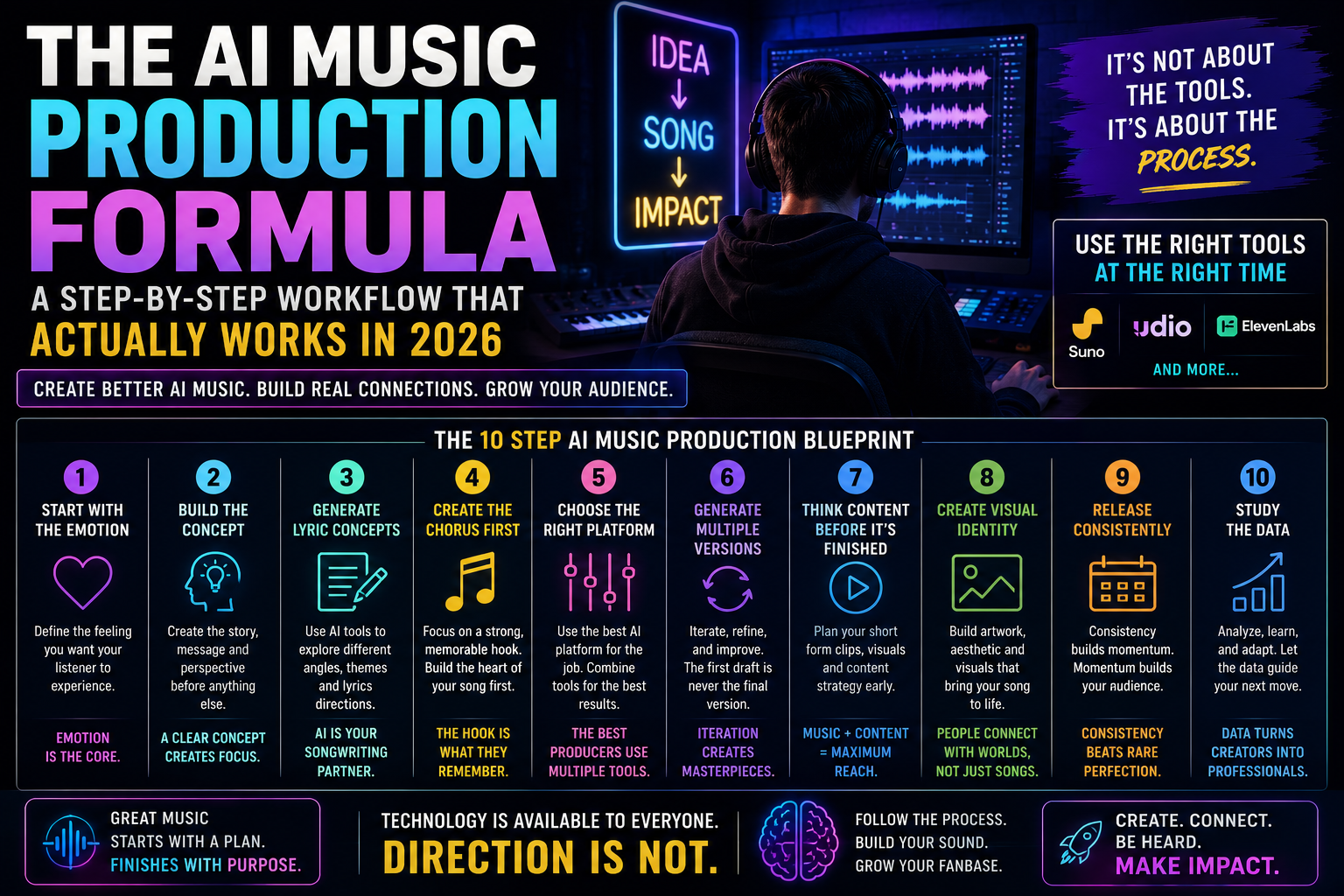
For most modern AI music producers, the ideal workflow looks like this:
Emotion First.
Concept Second.
Lyrics Third.
Chorus Fourth.
Music Generation Fifth.
Visual Branding Sixth.
Content Creation Seventh.
Promotion Eighth.
This sequence produces stronger results because every stage supports the next.
Starting with lyrics alone often creates directionless songs.
Starting with random music generation often creates generic content.
Starting with emotion creates purpose.
Purpose creates better music.
There is no magical AI prompt.
There is no secret platform.
There is no perfect workflow.
The biggest advantage in AI music today is clarity.
The producers who know exactly what they want usually outperform producers who simply generate endless songs and hope for a hit.
Technology is becoming available to everyone.
Direction is not.
The future belongs to the creators who combine creativity, strategy, consistency, and storytelling into a complete process.
That is the closest thing the AI music industry currently has to a formula for success.