The first wave of AI music focused on speed. Producers typed prompts, generated tracks, and experimented with automated composition tools that could create songs in seconds. That stage is now becoming normal.
The next phase is much bigger.
AI music platforms are rapidly evolving from simple generators into intelligent creative systems capable of understanding emotion, audience behaviour, visual storytelling, personal style, and real-time adaptation. The future of AI music is no longer just about generating tracks. It is about building entire creative ecosystems around artists and digital creators.
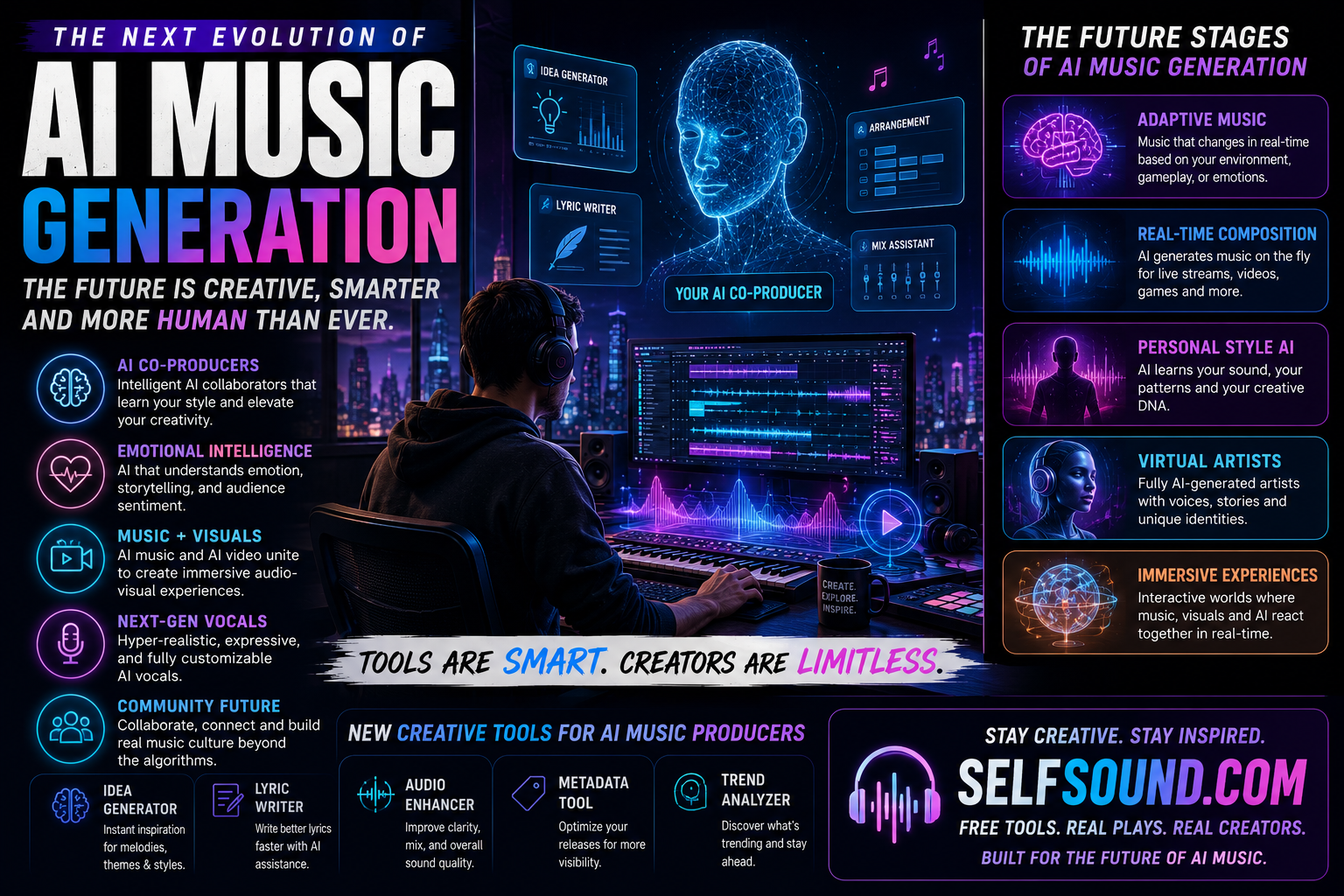
One of the biggest developments emerging right now is adaptive music generation. Future AI systems are expected to create music that changes dynamically depending on listener interaction, emotional response, gameplay environments, or video pacing. Instead of static tracks, producers may soon build living songs that evolve in real time.
Gaming companies are already experimenting with this concept heavily. AI-generated soundtracks that respond to player movement, emotional tension, or scene intensity are becoming increasingly realistic. This same technology is expected to spread into livestreaming, short-form content, virtual worlds, and immersive media experiences over the next few years.
The music industry is quietly moving toward “responsive audio” as the next creative frontier.
One major shift happening right now is the transition from AI generators into AI collaborators.
Early AI music tools focused on replacing manual creation. The next generation of systems is being designed to work alongside producers instead of replacing them entirely.
Future AI platforms are expected to understand producer habits, favourite chord progressions, mixing styles, vocal preferences, arrangement structures, and even emotional tendencies over time. Instead of generating random songs from scratch, AI systems may soon function more like intelligent studio partners.
Imagine an AI system that recognises your signature sound automatically.
An AI assistant that notices your songs are becoming repetitive and suggests new structures before your audience gets bored.
An AI system that studies listener retention data and recommends stronger transitions, more effective hooks, or different pacing strategies based on audience behaviour.
That future is arriving faster than many creators realise.
The producers who succeed in the next phase of AI music will likely be the ones who learn how to direct AI creatively instead of relying on automation blindly.
One of the biggest limitations of AI music today is emotional depth.
Most current systems can generate technically impressive tracks, but many still struggle with emotional progression, storytelling nuance, tension-building, and authentic human unpredictability.
That is now becoming the next major battleground.
Future AI music tools are expected to become significantly more emotionally aware. Developers are training systems to understand emotional pacing, lyrical vulnerability, cinematic atmosphere, audience sentiment, and contextual storytelling more effectively.
This could lead to AI systems capable of generating songs that adapt emotionally throughout a track instead of maintaining one flat mood from beginning to end.
Emotion-aware generation could also completely change soundtrack production.
AI systems may eventually generate music based on live audience reactions, facial expressions, viewer engagement metrics, or scene intensity in films and digital content.
For AI producers, this creates massive opportunities.
The future may belong less to producers who generate the most tracks and more to creators who understand emotional experience design.
One of the clearest future trends is the merger between AI music and AI visual creation.
The separation between musicians, filmmakers, animators, and digital creators is already collapsing.
AI creators are increasingly building complete entertainment experiences by combining generated music, cinematic visuals, animated worlds, storytelling clips, virtual performers, and interactive content together into unified creative brands.
This trend is only accelerating.
Future AI music tools are expected to integrate directly with AI video systems, allowing producers to generate synchronised visuals automatically based on rhythm, emotion, energy, and lyrical themes.
Instead of creating music first and visuals second, creators may soon generate entire audiovisual experiences simultaneously.
That changes what it means to be a music producer completely.
The future AI artist may look more like a creative director than a traditional musician.
AI vocals are evolving rapidly, and the next few years could completely reshape vocal production.
Current systems already generate convincing singing voices, but future tools are expected to become dramatically more controllable.
Producers may soon adjust emotional intensity, vocal fatigue, breathing patterns, whisper textures, vocal strain, and performance energy with precision controls inside AI generation systems.
Voice personalisation is also becoming a major trend.
Instead of choosing from generic AI voices, creators may eventually train custom vocal models tied directly to their own style, branding, and performance identity.
This raises major industry questions around ownership, licensing, artist identity, and synthetic performers.
Virtual AI artists are also expected to grow significantly.
Entire AI-generated music brands with synthetic personalities, evolving visual identities, AI-generated interviews, virtual livestreams, and interactive fan engagement systems are already beginning to appear across social platforms.
The next generation of AI music may not revolve around songs alone.
It may revolve around fully generated entertainment identities.
The future of AI music tools is not just about generating better songs.
It is about reducing creative friction.
Many new AI systems are focusing heavily on workflow acceleration, idea generation, creative organisation, visual branding, and production consistency.
This is where creator-focused platforms like Selfsound.com are becoming increasingly important for AI producers looking to stay creative consistently instead of burning out.
Selfsound.com is positioning itself around helping AI music creators maintain momentum, discover ideas faster, and stay productive creatively. Instead of focusing only on generation, the platform offers tools designed to help producers brainstorm concepts, improve lyrical creativity, organise releases, strengthen visibility, and develop stronger creative direction overall.
This matters because many producers eventually hit a wall where generation itself stops being the problem.
Direction becomes the problem.
Creative identity becomes the problem.
Consistency becomes the problem.
Platforms that help producers stay inspired, organised, and strategically creative may become more valuable over time than pure generation systems alone.
The next generation of AI music tools will likely focus heavily on assisting the creator mindset itself.
Another major future trend is community-driven discovery.
As streaming platforms become increasingly overcrowded, many AI creators are beginning to realise that algorithmic discovery alone is unreliable.
The future may shift toward creator ecosystems built around collaboration, shared audiences, niche scenes, and active participation rather than passive uploads.
Platforms that build genuine creator communities around AI music are likely to become increasingly important because audiences are beginning to crave identity, interaction, and culture instead of endless algorithmic content.
AI music creators who collaborate visually, musically, and socially may outperform isolated creators relying purely on automation.
The future AI music scene may feel less like a traditional music industry and more like interconnected digital creative networks.
Many people still believe AI music success is about finding the perfect prompt.
That thinking will age badly.
As AI generation becomes easier for everyone, creative direction will become far more important than generation itself.
The producers who stand out in the next era of AI music will likely be the creators who understand storytelling, branding, emotional design, audience psychology, visual presentation, and creative identity at a high level.
AI tools are becoming more powerful every month.
That means originality becomes more valuable, not less.
The future of AI music will not belong to creators who simply generate content endlessly.
It will belong to creators who build worlds around their music.