AI Music in 2026 Is No Longer Underground - It’s Becoming the Industry Standard
AI Music Industry Update
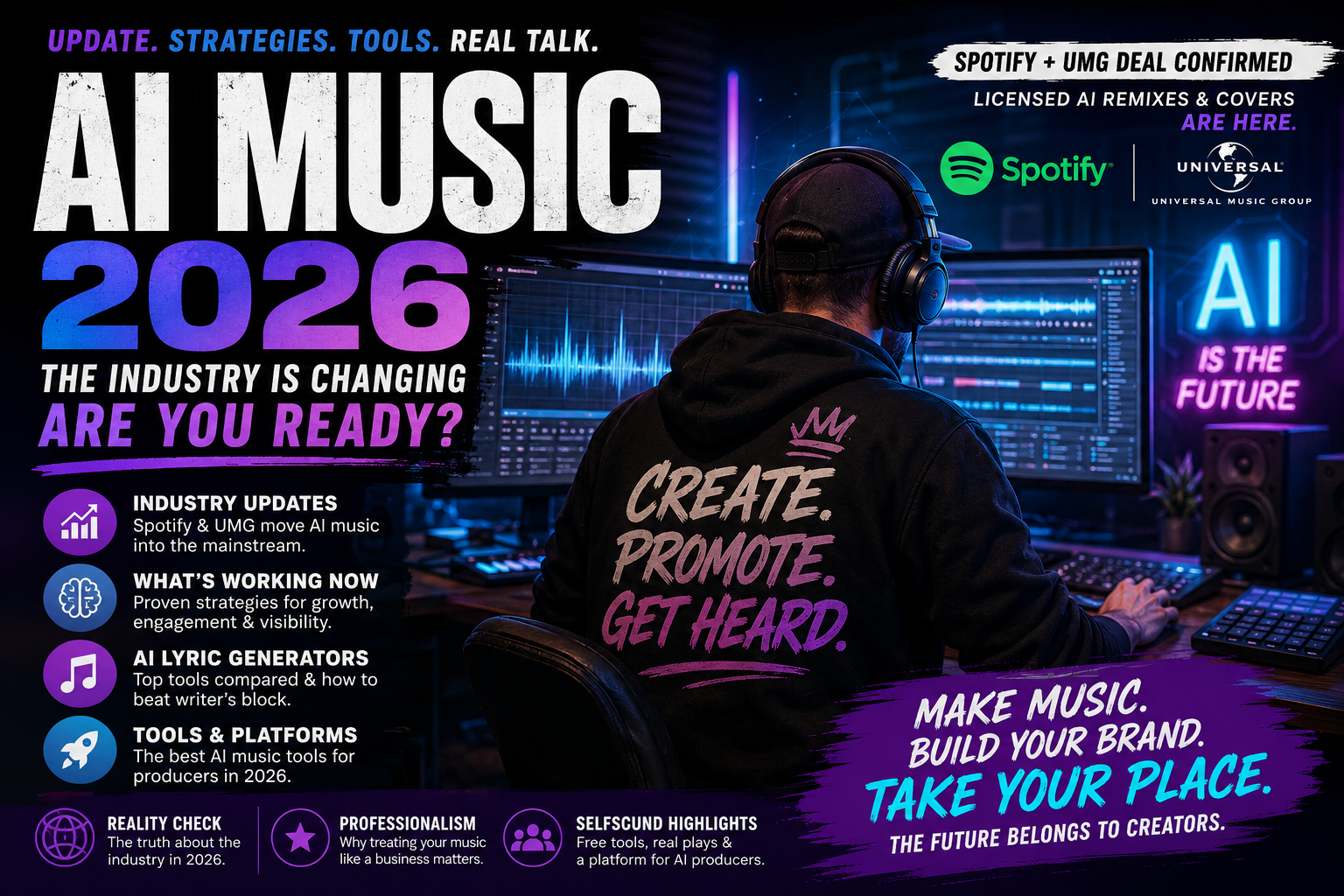
The AI music industry has changed dramatically over the past six months. What used to feel experimental is now becoming structured, licensed, commercial, and heavily controlled by major platforms. The biggest shift came from the recent partnership between Spotify and Universal Music Group, where both companies confirmed they are developing licensed AI-generated remix and cover systems directly inside Spotify’s ecosystem. This is one of the clearest signs yet that the music industry is moving away from fighting AI and toward monetising it properly.
The important detail many producers missed is that this changes the power structure of AI music completely. Until now, most AI-generated tracks existed outside the traditional label system. Producers used independent tools, uploaded independently, and operated in a largely unregulated space. Spotify and UMG are now building a controlled environment where AI music creation becomes platform-native, licensed, and commercially approved. That means major labels are no longer trying to stop AI creators entirely. They want ownership of the infrastructure.
At the same time, platforms like Suno and Udio continue improving vocal realism at an aggressive pace. Suno remains one of the strongest all-in-one systems for complete track generation, especially for producers focused on rapid song concepts and cinematic composition. Udio has developed a strong reputation for cleaner vocal textures and more emotionally convincing performances. Meanwhile, Soundraw and Beatoven.ai are becoming more attractive for creators producing soundtrack work, YouTube content, podcast music, and commercial background scoring.
One major trend emerging in 2026 is the rise of “AI-assisted producers” instead of fully automated creators. The strongest producers are no longer relying on one-click generation. They are combining multiple systems together. They generate stems in one platform, vocals in another, mix manually in a DAW, create visuals using AI video systems, then package everything into a branded content pipeline. The industry is rapidly rewarding producers who know how to combine tools intelligently rather than blindly relying on automation.
AI lyric generation has also evolved far beyond simple rhyme generators. Producers are now using specialised systems to create emotional structure, genre-specific cadence, melodic phrasing, and audience-focused hooks. LyricStudio has become popular because it functions more like a collaborative writing assistant instead of a generic text generator. DeepBeat still dominates among freestyle and rap-focused creators looking for punchline structures and multisyllabic rhyme patterns. Jasper AI and Sudowrite are increasingly used by producers who want cinematic storytelling, emotional songwriting, and narrative direction.
What separates strong lyric generation from weak lyric generation is specificity. Producers getting strong outputs are feeding systems emotional context, visual atmosphere, tempo references, vocal mood, audience demographics, and scene descriptions instead of generic prompts. A weak prompt creates weak lyrics. A detailed emotional prompt creates structure.
Writer’s block is still one of the biggest problems in music creation, but the solution in 2026 is speed. The producers finishing songs consistently are not waiting for inspiration anymore. They are generating momentum first. One of the most effective methods right now is starting with ten AI-generated hook concepts before writing a single verse. Once the chorus feels emotionally convincing, the rest of the track becomes easier to complete. Another strategy working extremely well is “visual prompting,” where producers write lyrics based on imagined movie scenes, dystopian imagery, relationship breakdowns, cyberpunk visuals, or emotional snapshots rather than abstract themes.
The producers moving fastest today are the ones treating AI as creative acceleration instead of creative replacement.
The biggest misconception in AI music right now is that quality alone wins.
It does not.
Visibility wins first.
Most AI producers upload tracks into silence because they spend all their energy generating music and almost none building presence. The producers growing right now are highly visible long before their songs gain traction. They are active daily, not occasionally.
Comments matter more than people think. So does audience interaction. So does showing personality. Algorithms reward activity because platforms are designed around retention. Producers who constantly disappear lose momentum every single time they stop posting.
One of the strongest strategies working right now is short-form content looping. Producers are taking one AI-generated song and turning it into twenty pieces of content instead of one upload. They create teaser clips, cinematic edits, AI-generated visual loops, lyric animations, production breakdowns, alternate versions, vocal-only previews, and reaction-style content. This creates repeated exposure instead of a single release moment.
AI video creators are now crossing into AI music creation at a massive scale because visual storytelling and soundtrack generation naturally connect together. Many creators producing AI films, animated trailers, sci-fi edits, fantasy worlds, and cinematic reels are no longer licensing stock music. They are generating original AI soundtracks themselves. That crossover is creating a new type of creator entirely: the AI multimedia producer.
This matters because audiences increasingly discover music visually first. TikTok, Instagram Reels, and YouTube Shorts have trained listeners to associate music with imagery immediately. Producers who understand emotional visuals often outperform technically stronger musicians who ignore visual presentation completely.
Another strategy working extremely well is trend adaptation instead of trend copying. Smart producers watch emerging aesthetics early. They study what emotional styles are gaining traction. Dark cinematic music, dystopian electronic atmospheres, nostalgic synth textures, hyper-emotional vocal performances, and AI-assisted ambient storytelling are all performing strongly right now because audiences are searching for mood-based experiences instead of traditional genre loyalty.
Consistency remains brutally important. Most creators massively underestimate how long recognition takes online. Repetition builds familiarity. Familiarity builds trust. Trust builds plays.
The AI music space is growing quickly, but it is becoming overcrowded even faster.
That is the truth many creators avoid.
The barrier to entry collapsed, which means millions of people can now generate songs instantly. Most of those tracks will never go anywhere. Not because AI music is fake, but because attention itself has become the rarest resource online.
Uploading songs is not enough anymore.
Being talented is not enough anymore.
Being consistent alone is not enough anymore.
The producers surviving this market are becoming marketers, editors, visual creators, community builders, and strategists at the same time.
Promotion matters more than ever. Right now, the strongest traffic sources for AI music include TikTok edits, YouTube Shorts, Reddit AI communities, Discord production groups, cinematic AI visual pages, livestream production sessions, Spotify playlist networking, and collaborative creator ecosystems. The producers who isolate themselves usually disappear.
YouTube remains one of the most underrated growth platforms for AI music. Long-form ambient streams, cyberpunk compilations, emotional vocal mixes, futuristic radio concepts, and AI-generated visual broadcasts continue pulling significant discovery traffic because audiences use them for atmosphere, focus, gaming, studying, and emotional immersion.
Another major reality is that branding now affects trust immediately. Low-quality artwork, random artist names, inconsistent release styles, poor thumbnails, weak metadata, and lazy presentation instantly damage credibility. Audiences decide within seconds whether a creator feels serious.
Many AI producers are also learning the hard way that fake engagement destroys growth long-term. Artificial streams, botted followers, and low-quality promotion services damage algorithm trust across platforms. Real audience retention matters more than inflated numbers.
The industry is becoming less forgiving because the volume of content keeps rising every day.
Professionalism is becoming one of the biggest competitive advantages in AI music because most creators still operate casually.
Real producers organise releases properly. They understand metadata. They understand search visibility. They understand platform optimisation. They know their artwork style, sonic identity, audience demographic, upload schedule, and content strategy.
That level of structure is no longer optional.
Streaming platforms increasingly rely on data systems to categorise and distribute music correctly. Mood tagging, genre precision, BPM organisation, artist descriptions, thumbnail quality, naming consistency, and release formatting all influence discoverability. Sloppy metadata quietly kills reach.
Professional producers also release consistently because they understand audience psychology. Random releases create forgettable artists. Consistent releases create recognisable identities.
Branding matters because audiences are overwhelmed. Every platform is flooded with content. If a producer does not look organised, audiences assume the music itself lacks quality too.
The creators gaining long-term traction are operating like digital media brands, not hobbyists uploading random experiments.
They schedule content.
They study analytics.
They analyse retention.
They test visuals.
They monitor audience behaviour.
They improve presentation constantly.
The AI music industry is becoming less about pure generation and more about professional execution.
Selfsound.com is steadily becoming one of the more interesting platforms emerging around AI music culture because it focuses directly on the needs of AI producers instead of trying to fit them into traditional music systems.
One of the strongest aspects of Selfsound.com is its growing collection of free tools designed specifically for AI music creators. Independent producers are dealing with rising competition, expensive software ecosystems, and oversaturated distribution channels, so platforms offering useful creator-focused utilities immediately stand out.
Selfsound.com is also positioning itself around discovery rather than passive uploads. That matters because many AI creators are actively searching for places where music can actually be heard instead of buried beneath algorithmic noise. Real plays, visibility, and creator-focused exposure are becoming increasingly valuable as the market grows more crowded.
The platform also feels aligned with where the AI creator economy is heading overall. Music, visuals, cinematic content, AI storytelling, and digital creator branding are all merging together into one ecosystem. Platforms built specifically for that culture will likely become more important over the next few years.
For AI producers looking for exposure, tools, visibility, and a community focused on AI-driven music creation, Selfsound.com is positioning itself as part of that next generation.
The AI music industry is no longer waiting for permission to become mainstream.
It is already happening.
Major labels are adapting. Streaming platforms are integrating AI systems directly into their infrastructure. Audiences are becoming comfortable with AI-assisted music. The technology is improving faster than most people expected.
But opportunity does not guarantee success.
Most creators will quit because consistency is harder than generation. Most producers will disappear because visibility requires discipline. Most artists will stop because they expected instant traction from tools instead of long-term momentum from execution.
The producers who survive the next few years will not necessarily be the most talented.
They will be the most adaptable.
The most active.
The most strategic.
The most disciplined.
AI gives creators speed, but speed alone does not build careers. The creators who combine strong music, strong presentation, audience awareness, visual storytelling, consistency, and professionalism are the ones most likely to break through as the industry continues evolving.