The debate surrounding AI music has entered a new phase, and it is no longer focused solely on whether artificial intelligence should be used in music production. The conversation is increasingly centred on transparency, attribution and how AI-generated works should be identified when released commercially.
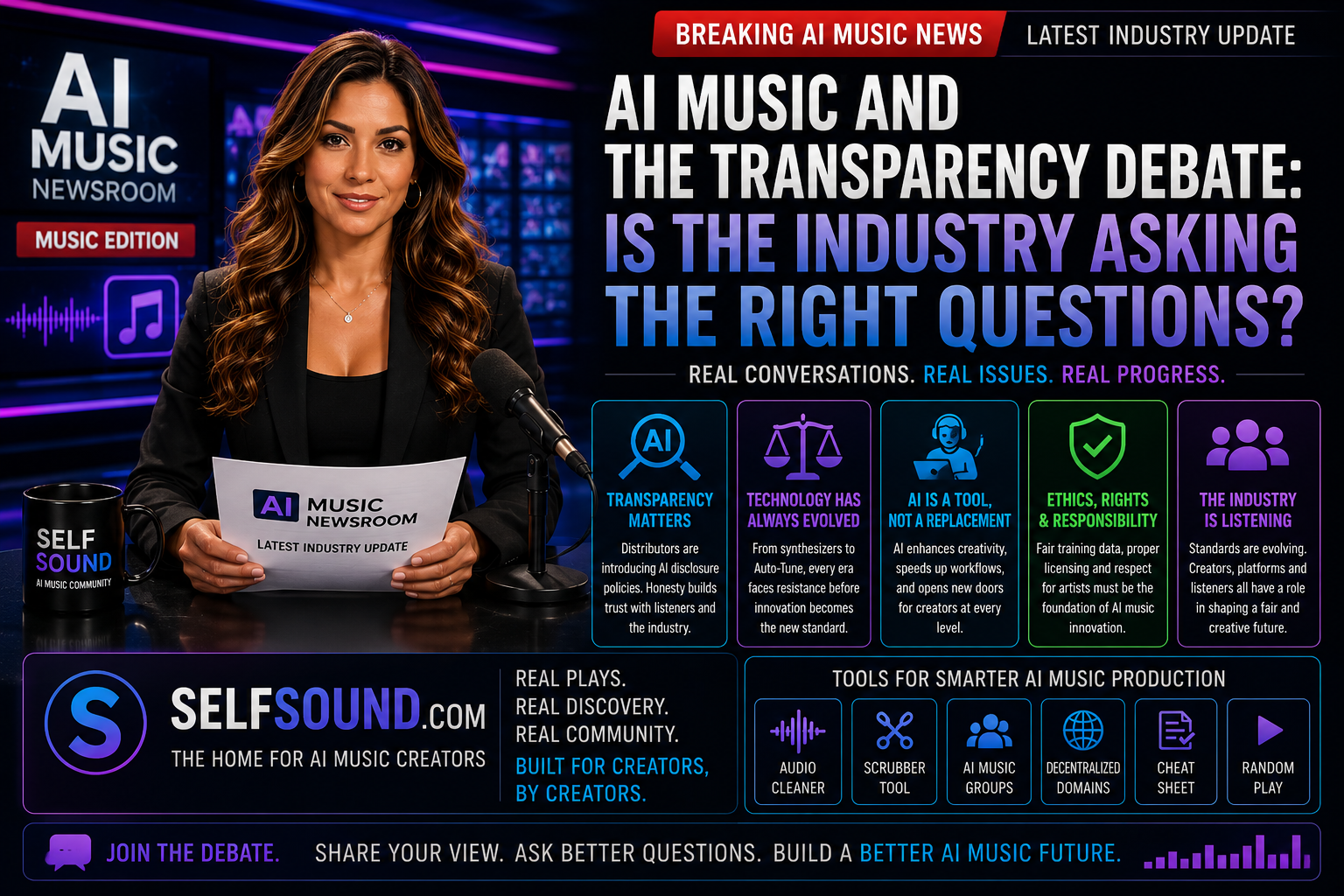
The image accompanying this discussion reflects a growing opinion shared by many AI music producers. Its central argument is that modern music production has relied on technology for decades, yet only AI-assisted creation is now being singled out for mandatory disclosure. It raises an important question that deserves thoughtful consideration rather than emotional reactions.
For generations, producers have used Digital Audio Workstations, drum machines, synthesizers, Auto-Tune, pitch correction, sample libraries, virtual instruments, mastering software and increasingly sophisticated production plugins. Every technological leap has changed the way music is created. Each innovation initially faced criticism before eventually becoming accepted as a standard part of professional production.
Artificial intelligence is simply the latest stage in that technological evolution. Unlike earlier tools, however, AI introduces additional legal and ethical questions around training data, voice cloning, copyright and attribution. These are genuine concerns that require practical solutions. At the same time, many creators argue that transparency should be applied consistently across the production process rather than focusing exclusively on one technology.
The industry's challenge is finding a balance that protects artists, informs listeners and encourages innovation without unfairly stigmatising creators who use AI responsibly as one component of a wider production workflow.
Professional AI producers are moving away from the idea of fully automated music creation and towards hybrid production workflows that combine artificial intelligence with traditional production skills.
The strongest releases today rarely come directly from a single AI prompt. Successful creators generate ideas using AI before refining arrangements inside professional Digital Audio Workstations, applying manual editing, vocal processing, mixing, mastering and creative decision-making. AI accelerates production, but human judgement continues to define the finished result.
Another significant trend is the growth of complete creator ecosystems. AI is now being used to assist with lyric writing, artwork, promotional videos, marketing copy, metadata management and audience engagement. Independent producers are operating with a level of efficiency that was previously available only to established production companies.
At the same time, new creator-focused platforms are emerging that recognise AI music as a legitimate creative discipline. Instead of treating AI-generated music as something separate, these platforms are building communities, discovery tools and production resources specifically designed to help creators improve quality, collaborate with other artists and reach genuine listeners.
The producers gaining momentum understand that music generation is only the beginning. Long-term success depends on workflow, consistency, branding and community engagement.
The image argues that transparency should apply to every production technology rather than AI alone. While that perspective highlights an inconsistency that many creators feel, the reality is more nuanced.
There is a meaningful difference between using a synthesizer, an equaliser or pitch correction to shape music that you have created, and using a generative AI system that may contribute melodies, lyrics, arrangements or vocals. Because generative AI can play a much larger role in the creative process, many distributors, labels and rights organisations believe additional disclosure is appropriate. That distinction is one reason the industry is introducing AI transparency policies.
At the same time, the image raises a broader point that resonates with many producers. Technology has always influenced music, and innovation has consistently been met with resistance before eventually becoming mainstream. Electronic instruments, digital recording, sampling and Auto-Tune all followed similar paths.
The creators succeeding today are not spending their time arguing about whether AI belongs in music. They are focusing on learning the tools, refining their production quality and building audiences.
Commercial clients are not asking whether a producer used AI. They are asking whether the music sounds professional, whether the licensing is clear and whether the creator can consistently deliver high-quality work.
That is where the industry is heading.
Artificial intelligence is becoming another production tool within a professional music career, but using it responsibly has become increasingly important.
Major distributors are introducing policies that encourage transparency around generative AI when it plays a significant role in creating a release. Some platforms now allow artists to disclose how AI contributed to lyrics, composition or vocals while making clear that creators must have the necessary rights to everything they publish. AI-assisted production tools such as mastering, noise reduction, vocal enhancement or editing generally do not require the same level of disclosure because they function as production aids rather than content generators.
Professional creators should view transparency as part of good business practice rather than a limitation. Keeping accurate production records, documenting creative workflows and understanding licensing requirements demonstrates professionalism and helps prepare music for future commercial opportunities.
The producers who will build lasting careers are those who embrace both innovation and accountability. AI should strengthen creativity, not replace originality or ethical decision-making.
As discussions around AI music continue to evolve, Selfsound.com remains focused on supporting creators rather than dividing them.
The platform has been built specifically for AI music producers and continues to expand through direct feedback from its growing community. Rather than concentrating solely on uploading songs, Selfsound is developing an ecosystem that helps creators improve production quality, organise their work and reach listeners who are genuinely interested in AI-assisted music.
A growing collection of free tools is available to support every stage of production. The Audio Cleaner helps prepare AI-generated tracks by reducing unwanted noise, removing embedded metadata and applying frequency shaping before mastering. The Scrubber assists creators in preparing cleaner production files, while additional production resources and workflow utilities continue to be added as the platform develops.
Selfsound also provides dedicated AI Music Groups where producers can exchange techniques, discuss new technologies, collaborate on projects and learn from one another. These communities encourage meaningful discussion around AI production instead of focusing on controversy alone.
One of the platform's most ambitious developments is its Decentralised Production Domains initiative, which explores blockchain-based producer identities using Ethereum Name Service and IPFS technology. This gives creators an opportunity to establish permanent producer identities that they control independently of any single platform, helping them build long-term brands around assets they genuinely own.
What makes Selfsound different is that it has been created by people who actively understand AI music production. Every new tool is designed to solve practical problems encountered by creators rather than simply adding features for marketing purposes. As AI music continues to mature, platforms that invest in creator success, ownership and professional workflows will become increasingly valuable.
Transparency matters. So do consistency, fairness and recognising that technology has always been part of music production.
The future of AI music should not become a debate between traditional musicians and AI creators. It should become a conversation about responsible innovation, clear licensing, creative integrity and giving audiences confidence in the music they enjoy.
Artificial intelligence is unlikely to replace musicians. It is becoming another instrument within the modern production studio.
The creators who succeed over the next decade will be those who combine artistic vision, professional workflows, ethical use of technology and strong personal branding.
AI may continue to evolve rapidly, but the qualities that define great producers remain unchanged: creativity, originality, discipline and the ability to connect with listeners through exceptional music.