The AI music industry has moved beyond the question of whether artificial intelligence belongs in music production. That debate is rapidly being replaced by a far more important discussion centred on ownership, transparency and long-term creator control.
Over the past year, AI music platforms have become dramatically more capable. Song generation is faster, vocal quality has improved, and producers now have access to sophisticated tools for lyric creation, mastering, stem separation, artwork generation and video production. The technology itself is no longer the limiting factor.
Instead, the industry is asking a different question. Once a song has been created, who owns it, who controls it, and where should it live?
That question is driving some of the biggest innovations now emerging across the AI music sector. Alongside improvements in generation technology, attention is shifting toward decentralised publishing, blockchain ownership, permanent content storage and creator-controlled distribution models.
Rather than relying entirely on traditional streaming platforms and centralised databases, many forward-thinking creators are beginning to explore technologies such as Ethereum Name Service (ENS), IPFS and blockchain-based publishing. These technologies allow artists to establish permanent digital identities, maintain greater control over their catalogues and reduce dependence on third-party platforms whose policies and algorithms can change overnight.
AI has democratised music creation. The next evolution is giving creators greater ownership of everything they produce.
The producers building sustainable careers today are no longer thinking like musicians alone. They are thinking like media companies.
The most successful AI creators are developing complete production pipelines that begin with planning, continue through AI-assisted creation and editing, and finish with professional publishing, branding and audience development.
Hybrid production has become the industry standard. AI generates ideas, while traditional Digital Audio Workstations refine them into commercially viable productions. Every successful release is supported by strong artwork, promotional video, metadata optimisation and consistent branding across multiple platforms.
Another trend gaining momentum is creator independence. Rather than relying entirely on social media algorithms or streaming services to build an audience, producers are investing in assets they actually own. Personal websites, direct mailing lists, community platforms and decentralised publishing are becoming increasingly valuable because they remain under the creator's control regardless of changes made by external companies.
Professional producers understand that every release should strengthen a long-term catalogue. Songs become assets. Videos become marketing tools. Artwork becomes part of a recognisable brand identity. Every production contributes to building a business rather than simply generating another upload.
The creators making the greatest progress are investing just as much time into their infrastructure as they do into creating music.
The reality is that AI music generation has become widely accessible.
Professional execution has not.
Today, almost anyone can generate a convincing piece of music within minutes. Standing out has become the difficult part. Visibility is increasingly determined by branding, organisation, presentation and ownership rather than technology alone.
Many creators continue to build their careers entirely on accounts that they do not own. Social media profiles, streaming accounts and distributor dashboards are valuable marketing tools, but they remain controlled by third-party companies. Policy changes, algorithm adjustments, account suspensions or evolving AI regulations can dramatically affect how creators reach their audiences.
This is encouraging a growing number of professional producers to think differently about digital ownership.
Instead of treating platforms as permanent homes, they are treating them as marketing channels that direct listeners back to assets they fully control.
The creators building long-term businesses are recognising that an account is temporary, but a professionally managed brand can exist independently of any single platform.
Professionalism today extends far beyond producing excellent music.
It means building an infrastructure that protects your catalogue, your identity and your future opportunities.
Distributors are increasingly asking artists to disclose how AI has been used during production. Licensing frameworks are evolving. Copyright policies continue to develop. Transparency is becoming part of professional publishing rather than something to avoid.
At the same time, ownership is becoming equally important.
Professional producers increasingly understand the value of controlling their own websites, maintaining organised catalogues, preserving production files, documenting licensing rights and building direct relationships with audiences.
The industry is gradually moving away from platform dependency and toward creator ownership.
Technology generates songs.
Professional infrastructure builds careers.
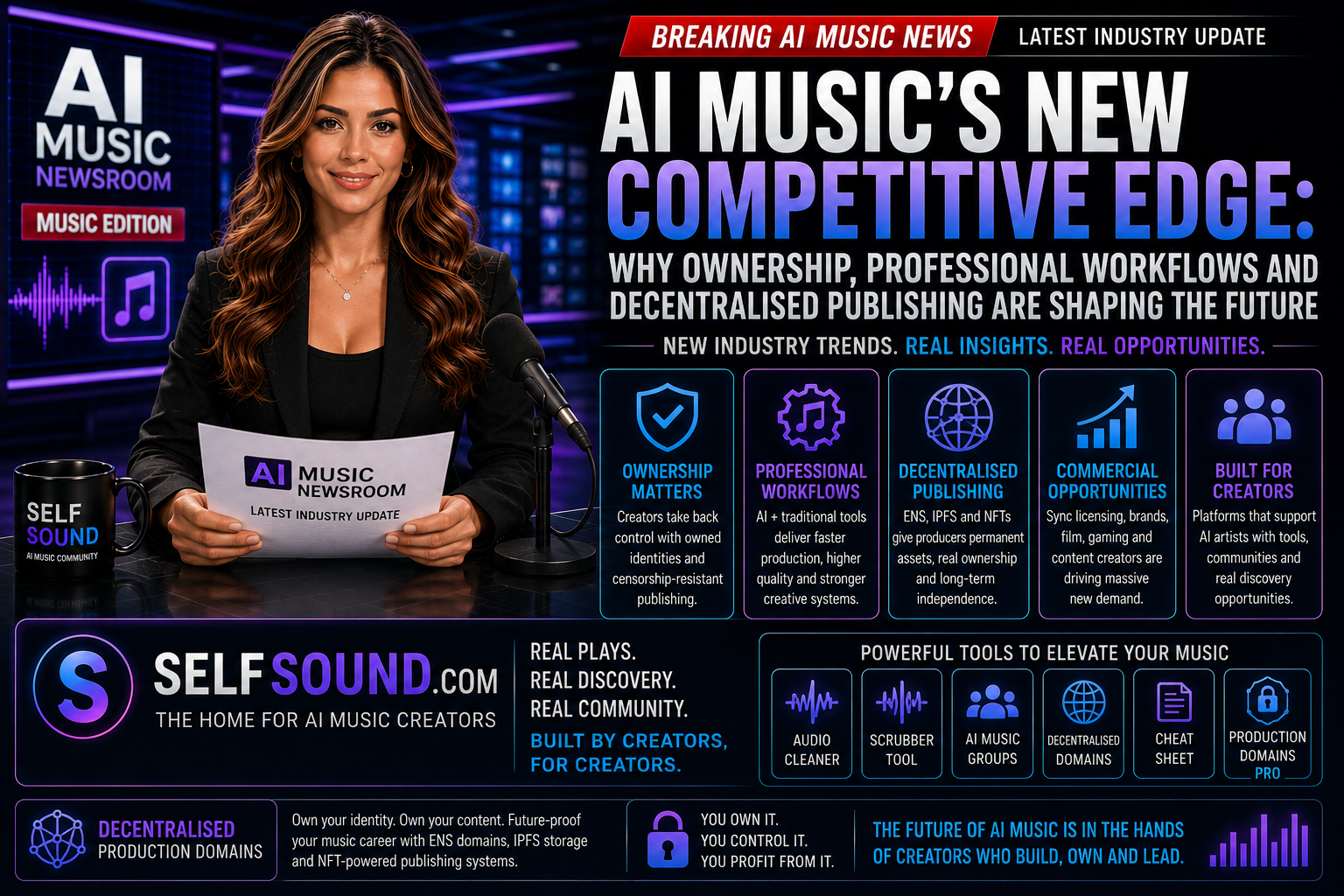
Selfsound.com continues to position itself as one of the most forward-thinking platforms dedicated entirely to AI music creators. Rather than simply offering another location to upload tracks, Selfsound is steadily building a complete production ecosystem designed around the real needs of professional AI producers.
Alongside its growing collection of free creator tools, including the Audio Cleaner, Scrubber and production utilities, Selfsound is now developing one of its most ambitious initiatives to date: Decentralised Production Domains.
This new system represents a significant shift in how AI music creators can manage their professional identity.
Instead of relying solely on usernames inside centralised platforms, producers can search for and register their own blockchain-based production domain using Ethereum Name Service technology. A producer name becomes more than simply a profile. It becomes a permanent digital asset owned directly through the creator's wallet.
Unlike traditional platform accounts, these domains cannot simply be removed because of policy changes, algorithm updates or platform decisions. Ownership remains with the producer rather than the platform.
The concept is straightforward but extremely powerful.
A producer first secures their unique production domain. Once registered, that domain becomes the permanent home for everything connected to their creative business.
The producer can then publish a professional landing page linked directly through ENS records. This becomes the central hub for music releases, press kits, sponsorship information, merchandise, licensing enquiries, NFT collections and future projects.
Rather than uploading content to conventional hosting services alone, Selfsound encourages producers to explore publishing their music, videos, artwork and promotional assets using IPFS, the InterPlanetary File System. Because files are referenced through content identifiers rather than traditional servers, creators gain significantly greater resilience and long-term control over their catalogue.
Every release can then be connected directly to NFTs, allowing tracks, albums, collector editions, licensing rights, backstage passes and premium digital experiences to become products inside a producer-controlled storefront.
Instead of routing business entirely through third-party marketplaces, creators establish their own permanent commercial headquarters.
This is the philosophy behind Decentralised Production Domains.
Platforms become promotional channels.
The producer domain becomes the business.
Selfsound's Production Domain interface makes the process accessible by allowing producers to search available ENS names, verify availability through blockchain or RPC lookup, and begin building a professional decentralised identity from a single location.
The platform also provides educational resources explaining ENS records, IPFS publishing, producer branding and decentralised ownership so that AI musicians can understand not only how these technologies work, but why they are becoming increasingly relevant.
Alongside these developments, Selfsound continues expanding its AI Music Groups, providing dedicated communities where producers can collaborate, discuss new technologies, share production techniques and support one another as the industry evolves.
Combined with AI News, Billboards, Videos, Random Play, creator profiles and an expanding collection of free production tools, Selfsound is gradually becoming far more than a music-sharing website.
It is becoming an operational platform designed to help AI music producers build professional careers from creation through to ownership.
The next chapter of AI music will not be defined solely by better generators or faster production tools.
It will be defined by ownership.
The creators who build recognisable brands, control their own infrastructure, understand decentralised publishing and maintain professional production standards will be in the strongest position as the industry continues to evolve.
Generation technology will continue to improve for everyone.
Ownership, professionalism and strategic thinking will become the qualities that separate hobbyists from serious production companies.
The future of AI music is no longer just about making great songs.
It is about building an independent creative business where your identity, your catalogue and your audience remain under your control for years to come.