AI Music's Next Evolution: Why Trust, Transparency and Workflow Are Defining the Future
The AI music industry is entering a new phase that is significantly different from the rapid experimentation seen over the past two years. The focus is no longer simply on generating convincing songs. Instead, the conversation is shifting toward transparency, responsible AI use, commercial readiness and professional production workflows.
Recent developments across the music industry show growing support for standardised AI attribution. Major industry organisations, including the Recording Industry Association of America (RIAA), the International Federation of the Phonographic Industry (IFPI), The Recording Academy and SAG-AFTRA, have backed new initiatives designed to distinguish between fully AI-generated music and music that has been created by artists using AI as part of their workflow. The objective is not to discourage AI creativity, but to give listeners greater transparency while allowing responsible creators to continue embracing new technology. (People.com)
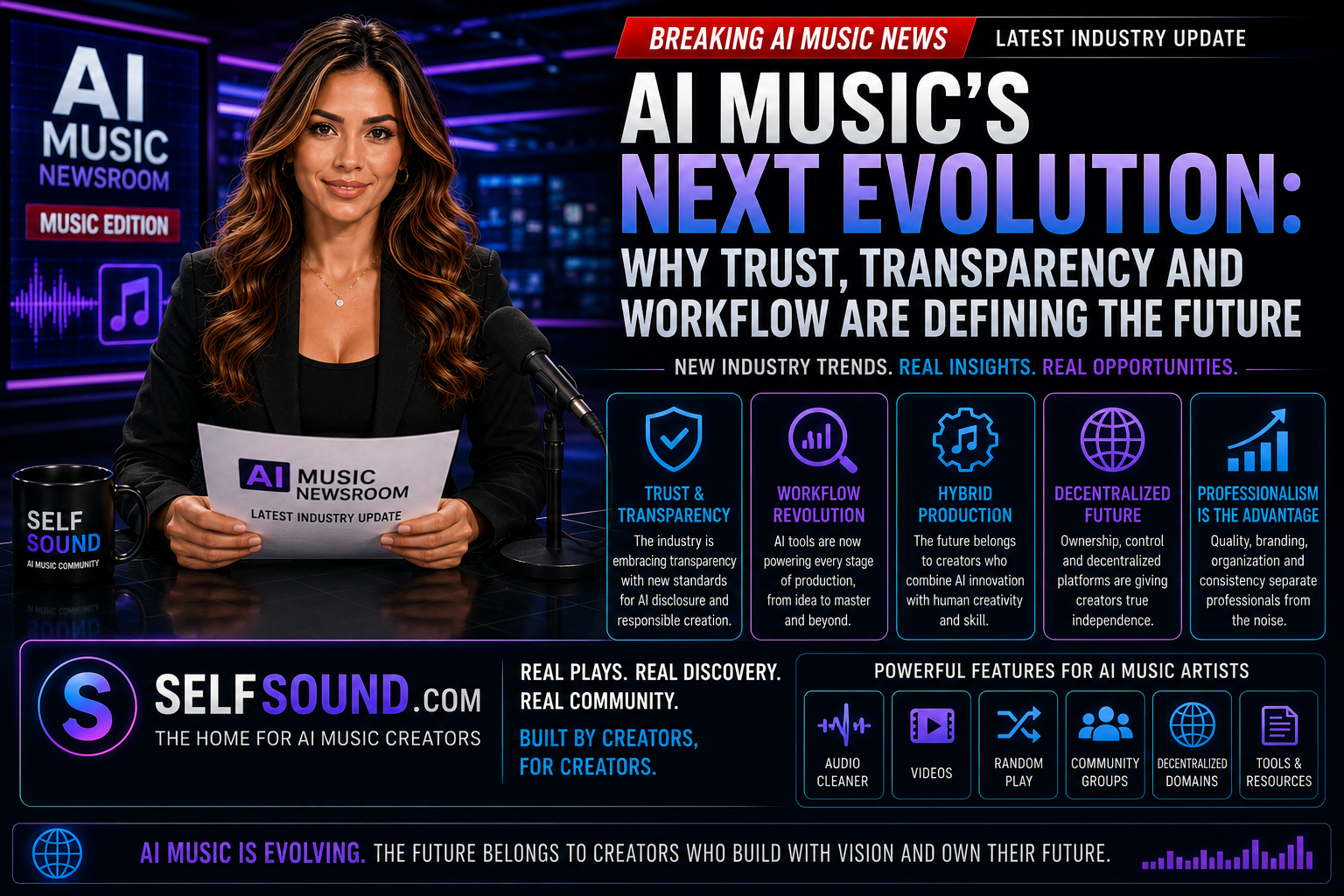
At the same time, AI music creation itself is becoming more sophisticated. Rather than relying solely on text prompts, producers are increasingly combining generative music platforms with traditional Digital Audio Workstations, AI mastering software, vocal enhancement, stem editing and video production tools. The industry is gradually recognising that AI is most valuable when it accelerates creativity rather than replaces it.
Perhaps the biggest change is that AI is becoming infrastructure rather than novelty. Music generation is no longer the destination. It is the starting point of a much larger creative process that includes editing, branding, publishing, licensing and audience development.
The producers building successful careers today are thinking beyond music generation. They are building complete creative systems.
Hybrid production has become one of the strongest trends in AI music. Creators are generating initial ideas with platforms such as Suno, Udio and other emerging AI tools before refining those ideas inside professional editing software. Mixing, mastering, arrangement, vocal processing and creative editing remain essential parts of the workflow because they give every release a recognisable identity that cannot be achieved through prompting alone.
Another important shift is the growing use of AI for every stage of production rather than only composition. Lyrics, artwork, promotional videos, social media content, metadata management and marketing materials are increasingly being produced using AI-assisted workflows. This allows independent creators to operate with the efficiency of much larger production teams while maintaining creative control.
Commercial opportunities are also expanding beyond streaming. Independent filmmakers, YouTube creators, podcast producers, game developers and advertising agencies are looking for original music that can be delivered quickly and legally. Producers who understand licensing, organisation and professional delivery standards are finding opportunities because they can produce complete creative packages instead of simply supplying audio files.
The creators gaining momentum are not publishing the highest number of songs. They are publishing fewer, higher-quality releases supported by consistent branding, regular audience engagement and professional presentation.
The reality is that AI music has become a professional business rather than a technical experiment.
Creating music is easier than it has ever been. Building an audience remains just as difficult.
Every day, thousands of AI-generated tracks are uploaded across streaming services and music platforms. Most receive very little attention because discoverability has become the industry's greatest challenge. Recent academic research examining AI-generated music found that the overwhelming majority of mass-produced AI releases attract very few listeners, reinforcing the importance of quality over quantity.
This means creators can no longer rely on algorithms to build their careers. Visibility comes from active participation, community engagement, professional branding and consistently releasing music that demonstrates genuine creative effort.
The industry is also becoming more selective. Distributors, streaming services and rights holders are introducing improved AI detection, attribution systems and metadata standards. The era of uploading unlimited, low-effort AI content in the hope that something becomes successful is rapidly disappearing.
Professional creators are responding by investing more time in refinement, audience building and long-term catalogue development instead of chasing rapid output.
Professionalism is no longer simply a competitive advantage. It is becoming a requirement for anyone intending to build a sustainable AI music career.
One of the biggest developments this year is the increasing emphasis on AI transparency during music distribution. Several distributors now ask creators to disclose whether AI was used during the creation of lyrics, composition, vocals or audio production. DistroKid has introduced AI Credits that allow artists to specify how AI contributed to a release, while making it clear that creators must own the necessary rights and avoid impersonation or mass-generated spam. AI-assisted production tools such as intelligent mastering or vocal enhancement generally do not require disclosure because they function as production tools rather than content generators. (DistroKid Help Center)
Other distributors are introducing their own AI policies based on principles of consent, control, compensation and transparency. TuneCore, for example, has stated that it supports responsible AI-assisted music creation only where creators can demonstrate appropriate rights and where the underlying AI models rely on properly licensed datasets. (TuneCore)
This reflects a broader industry movement. AI is no longer viewed as something that needs to be hidden. Responsible disclosure is becoming part of professional music publishing, much like songwriter credits, producer credits and publishing information.
The producers who will thrive over the coming years will be those who understand licensing, maintain organised project files, build recognisable brands and prepare every release to commercial standards. AI may generate ideas, but professionalism transforms those ideas into valuable creative assets.
As AI music production becomes increasingly sophisticated, Selfsound.com continues to evolve as a platform designed specifically for AI music creators rather than treating AI as an afterthought.
One of the platform's greatest strengths is its growing collection of free production tools that help artists improve both workflow and audio quality before publishing their music. Tools such as the Audio Cleaner, Scrubber and Cheat Sheet continue to simplify common production tasks, while the Production Domains Pro section provides additional resources for creators looking to operate at a more professional level.
Selfsound also remains committed to helping artists receive genuine exposure. The platform has been built around real plays, real discovery and a community that actively supports AI music creators. Instead of competing against massive streaming catalogues, artists have the opportunity to share their work with listeners who are specifically interested in AI-assisted music production.
Every new feature added to Selfsound reflects direct feedback from its community. Created by people who genuinely care about AI music generation, the platform continues to introduce practical tools that solve real production problems while giving creators more opportunities to improve their music, build their audience and develop sustainable careers.
The AI music industry is becoming more mature, more transparent and more professional.
Generation technology will continue to improve, but the competitive advantage is already moving elsewhere. Workflow efficiency, commercial awareness, branding, audience engagement and responsible AI use are becoming the qualities that separate professional creators from casual users.
The future belongs to artists who embrace AI as a creative partner while maintaining the discipline, originality and professionalism that have always defined successful music careers.
AI can accelerate creativity, but it is still the creator who determines the quality, integrity and long-term value of the music they choose to share with the world.