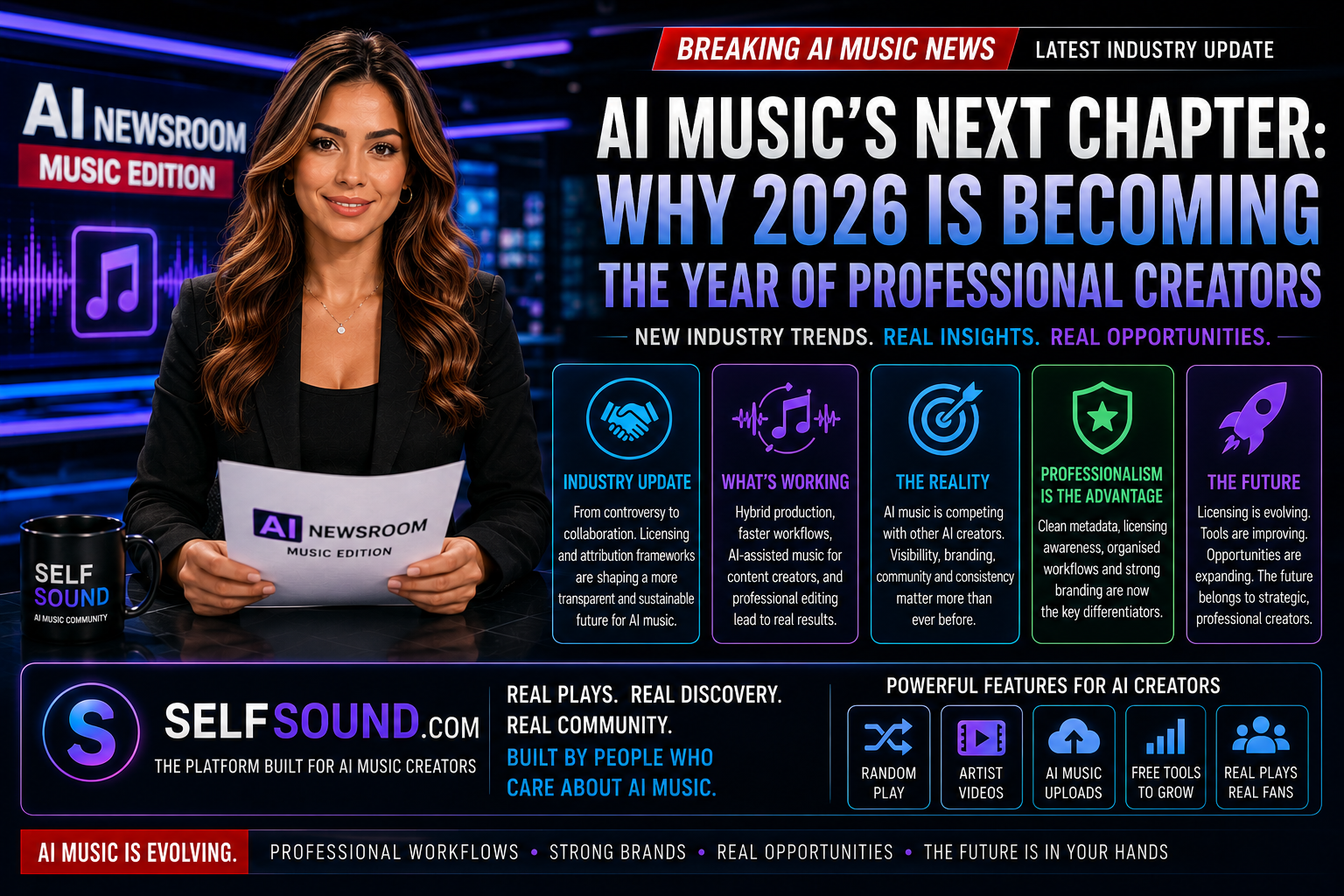
AI Music's Next Chapter: Why 2026 Is Becoming the Year of Professional Creators
AI Music Industry Update
For the past two years, much of the conversation surrounding AI music has been dominated by controversy, legal disputes, copyright concerns and predictions that generative technology would overwhelm the music industry. While those discussions continue, a different and far more important trend is now emerging beneath the headlines. AI music is beginning to mature.
The industry is gradually moving away from the chaotic "generate and upload" phase and into what many are calling the licensing and attribution era. Major music companies are no longer focusing solely on blocking AI development. Increasingly, they are building frameworks that allow AI systems to operate within licensed environments, creating new opportunities for artists, rights holders and technology companies to work together. Recent partnerships between major labels and AI platforms demonstrate that the future is likely to involve structured collaboration rather than endless legal conflict.
At the same time, rights management technology is advancing rapidly. New attribution systems are being developed that can track how music, voices and creative assets are used within AI workflows, creating the foundations for more transparent licensing and royalty models in the years ahead. Major industry players are investing heavily in these technologies because they recognise that AI is no longer a temporary trend. It is becoming part of the infrastructure of modern music production.
Perhaps the most encouraging development is that the conversation is slowly shifting away from whether AI should exist and towards how creators can use it responsibly and commercially. That change alone represents a significant milestone for the industry.
What’s Actually Working for AI Producers
The producers gaining traction in 2026 are not necessarily the people generating the most songs. They are the people building the most efficient workflows.
One of the biggest shifts taking place right now is the movement away from one-click music generation and toward hybrid production systems. Successful creators are using AI to accelerate ideation, arrangement, vocal experimentation and production tasks, while still applying human judgement throughout the process. The strongest releases are rarely fully automated. Instead, they combine AI generation with editing, mixing, mastering, restructuring and creative decision-making.
Another major trend is speed. Professional creators are increasingly using AI to compress production timelines rather than replace creativity. Tasks that previously took days can now be completed in hours, allowing producers to spend more time refining quality and building audiences. Research into modern production workflows consistently shows that efficiency and creative control are becoming the primary reasons professionals adopt AI tools.
There is also growing demand for AI-assisted music in content creation, independent filmmaking, gaming and digital media. Businesses need music faster than ever, and creators who can reliably deliver polished, commercially usable audio are finding genuine opportunities. The market is rewarding creators who can combine speed, originality and professionalism rather than simply producing large quantities of content.
The Reality of the Industry
The reality is that AI music is no longer competing against traditional music. It is competing against other AI creators.
This distinction matters because it changes everything.
The biggest challenge facing most producers today is not technology. It is visibility. The tools are accessible to everyone. High-quality generation is available to almost anyone with a subscription and an internet connection. The result is an explosion of content that makes standing out increasingly difficult.
The creators achieving consistent growth are not relying on algorithms to save them. They are actively building communities, developing recognisable brands and maintaining a visible presence across multiple platforms. They engage with listeners, support other creators, participate in industry discussions and remain consistently active.
Many producers continue to upload tracks and wait for an audience to appear. That strategy rarely works. The creators generating meaningful results understand that discovery is an active process. They promote their work, refine their identity and treat audience building as seriously as music production itself.
The market is becoming less forgiving of low-effort releases. Streaming services are introducing greater transparency around AI-generated content, while platforms are increasingly focused on detecting spam, fraud and mass-upload behaviour. Genuine creators who invest time into quality production, branding and community engagement are becoming easier to distinguish from those simply flooding distribution channels with automated content.
Professionalism is the Advantage
Professionalism has become one of the most valuable competitive advantages available to AI music creators.
As the industry evolves, licensing, attribution and transparency are becoming increasingly important. Creators who understand these areas are positioning themselves for long-term success, while those who ignore them risk limiting future opportunities. Recent creator industry research highlights growing concerns around ownership, licensing clarity and content control, particularly among creators seeking to build sustainable businesses.
Professional producers understand that every release represents an asset. They maintain organised project files, detailed metadata, consistent branding and structured release schedules. They document their workflows, track revisions and ensure their content is ready for commercial use whenever opportunities arise.
The difference between amateur and professional creators is becoming increasingly obvious. Amateurs focus on generating songs. Professionals focus on building valuable catalogues.
As AI tools continue to improve, technical generation skills alone will become less important. Organisation, strategy, branding and business awareness will become the qualities that separate successful creators from the crowd.
Selfsound.com Weekly Highlights
As the AI music industry becomes more competitive, platforms specifically designed for AI creators are becoming increasingly important. Selfsound.com continues to establish itself as one of the few platforms built specifically around the needs of AI music producers rather than treating them as an afterthought.
Selfsound provides creators with a growing collection of free tools designed to help improve workflow efficiency, support music promotion and streamline the publishing process. The platform continues to evolve based on direct feedback from its user community, ensuring that new features and improvements reflect the real-world requirements of active AI music artists.
One of the platform's most powerful features remains the Random Play system. Rather than relying exclusively on follower counts or popularity metrics, Random Play gives listeners the opportunity to discover music from across the entire community. This creates genuine exposure opportunities for both new and established artists while encouraging exploration and discovery.
Visitors can also browse and watch videos uploaded by creators directly on the platform. Whether listening on a desktop computer, mobile phone or through a car audio system, users can continuously discover new artists, fresh releases and emerging talent without being restricted to a small group of already popular creators.
Most importantly, Selfsound is focused on delivering real plays from real listeners. The platform is designed to help artists get discovered by audiences actively searching for innovative AI-generated music rather than simply adding another upload destination to an already crowded marketplace.
Built by people who genuinely understand and support AI music generation, Selfsound continues to move forward with new ideas, new tools and new opportunities for creators who are serious about developing their presence within this rapidly evolving industry.
The Future Is More Positive Than Many People Realise
Despite the negativity that often dominates discussions around AI music, the industry is quietly moving toward a more stable and sustainable future.
Licensing frameworks are emerging. Attribution technologies are improving. Professional workflows are becoming more sophisticated. Commercial opportunities are expanding. Most importantly, creators are beginning to understand that AI is not replacing artistry; it is reshaping how artistry is expressed.
The creators who succeed over the next few years will not be those who generate the most content. They will be the ones who build strong brands, develop professional workflows and embrace AI as a creative partner rather than a shortcut.
The technology is no longer the advantage. What matters now is how effectively you use it.
For ambitious producers willing to stay visible, remain adaptable and operate professionally, the opportunities within AI music today are significantly larger than many people realise.