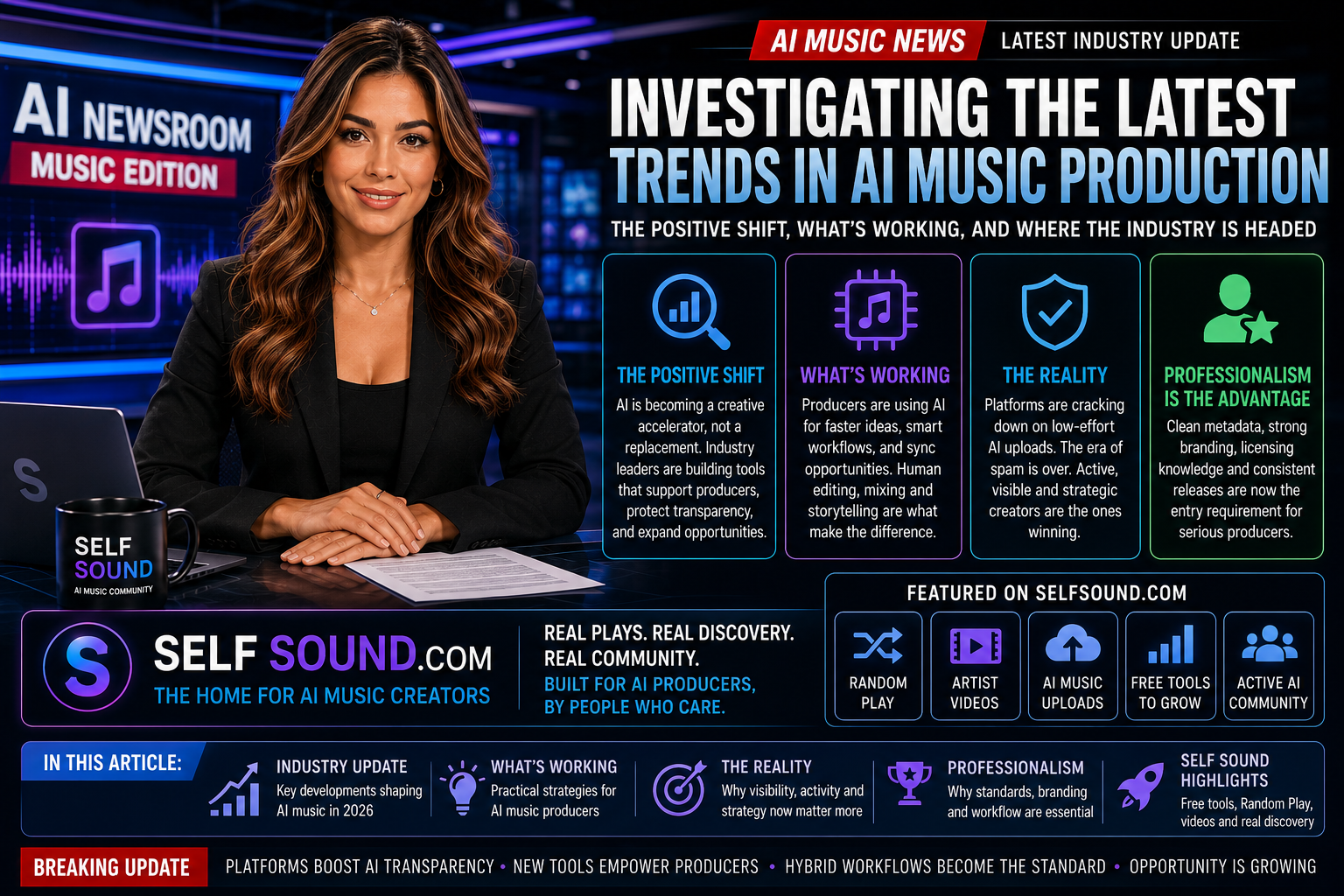
The Positive Shift Happening Behind the Headlines.
AI Music Industry Update.
While much of the conversation around AI-generated music remains focused on lawsuits, streaming crackdowns, and fears of automation, a different story is quietly unfolding inside the creator economy. The latest industry data shows that AI music is no longer being treated as a novelty or a shortcut. Instead, it is becoming a professional production tool that is helping independent artists, video creators, game developers, and media companies create music faster, more efficiently, and with greater creative control than ever before.
The biggest change in 2026 is not the quality of AI-generated songs. It is the shift toward AI-assisted workflows rather than fully AI-created music.
New tools from companies such as Splice, Stability AI, and Apple are being designed to work alongside producers instead of replacing them. Splice recently introduced generative sample tools that create variations of existing sounds while still compensating the original sample creators, a move that many in the industry see as a major step toward more ethical AI music production. At the same time, Stability Audio 3.0 has moved beyond short experimental clips and is now generating longer, more structured compositions that can be integrated into real production workflows. Apple's latest Logic Pro updates are also adding AI-powered production features directly into professional music software, signaling that AI is becoming part of mainstream studio production rather than a separate category of music creation.
This is the positive trend that many people are missing: AI is increasingly being used to accelerate creativity, not eliminate it.
Producers are using AI for idea generation, arrangement suggestions, vocal processing, sound design, mastering assistance, and rapid prototyping. The final records that perform best commercially are still heavily shaped by human decisions, editing, mixing, and artistic direction. The industry is slowly moving away from the simplistic 'AI versus human' debate and toward a hybrid model where AI becomes another tool in the producer's arsenal.
The financial side of the market is also expanding. Analysts project strong growth in AI music software, cloud-based production platforms, and AI-assisted audio tools throughout the rest of the decade, driven by demand from content creators, advertisers, podcasters, and independent musicians.
Source: Industry trend reports and market forecasts, 2026.
The producers getting real results right now are not the ones generating hundreds of songs a day.
They are the creators who treat AI as a production accelerator and then put in the work to turn those ideas into finished records.
What is working is surprisingly straightforward: generate fewer tracks, edit them aggressively, rebuild arrangements inside a DAW, create original artwork and video content, maintain a consistent release schedule, and build a recognizable brand across multiple platforms.
AI is excellent at speed. It can generate melodies, chord progressions, textures, and vocal ideas in minutes. But speed only creates opportunity. The producers who stand out are the ones who use that extra time to focus on mixing, storytelling, visuals, and audience engagement.
Another trend gaining momentum is AI-assisted sync music. Independent filmmakers, YouTubers, game developers, and advertisers need affordable, original music that can be delivered quickly. Producers who understand licensing, metadata, and commercial production standards are finding opportunities in this space because they can create custom music faster than traditional production workflows allow.
The blunt reality is that AI-generated music performs best when it stops sounding obviously AI-generated.
Human editing, human taste, and human presentation are still the factors that separate professional releases from disposable content.
There is definitely negativity surrounding AI music, and some of it is justified.
Streaming platforms are becoming more aggressive about detecting mass-uploaded AI tracks. Tidal recently announced that fully AI-generated music will be labeled and demonetized, while other services are investing heavily in AI detection systems to combat fraud and spam uploads.
Recent platform policy updates show a growing focus on transparency, labeling, and fraud prevention for AI-generated music.
But this does not mean AI music is dead.
It means the era of low-effort AI uploads is ending.
The creators who are succeeding are active, visible, and strategic. They are building communities, collaborating with other producers, posting videos, sharing production processes, and treating every release as part of a larger brand. The people who generate a song, upload it, and disappear are being buried by the sheer volume of content entering the market every day.
The industry is becoming more selective, not less.
Platforms want transparency. Audiences want authenticity. Commercial clients want reliability. That creates an advantage for producers who are willing to show their workflow, explain their creative process, and demonstrate that AI is one component of a larger production pipeline.
The negativity often focuses on replacement. The opportunity is in augmentation.
AI is not removing the need for producers. It is increasing the value of producers who know how to direct, refine, and finish AI-generated material professionally.
In 2026, professionalism is not optional for AI music creators. It is the entry requirement.
That means maintaining clean metadata, organized project files, proper licensing records, consistent branding, high-quality artwork, and a planned release calendar. It means understanding which platforms allow AI-assisted music, which require disclosure, and how to prepare tracks for commercial use.
The most successful AI producers are operating more like media companies than hobbyists. They have content pipelines, visual identities, distribution strategies, and audience-building systems. They know that a great track is only one part of the business.
This is where many creators fall behind. They focus entirely on generation and ignore presentation. Meanwhile, professional producers are building catalogs that are searchable, licensable, discoverable, and ready for sync opportunities, social media campaigns, and commercial partnerships.
The technology has become accessible to everyone. Professional execution has not.
As AI music production becomes more competitive, platforms built specifically for AI creators are becoming increasingly important.
Selfsound.com is positioning itself as more than a music hosting site. It is developing into a dedicated ecosystem for AI music producers who want real plays, real discovery, and real feedback from listeners who are actively interested in AI-generated and AI-assisted music.
One of the platform's standout features is the RANDOM PLAY system, which continuously introduces listeners to new artists and tracks across the Selfsound community. Instead of relying solely on followers or algorithms, visitors can discover fresh music automatically, making it easier for emerging producers to be heard by people who might never have found them otherwise.
Selfsound also allows users to upload and showcase videos alongside their music, creating a more complete artist profile. This has become particularly valuable for AI creators who are combining music generation with AI video production, visual storytelling, and social media content. Listeners can explore new tracks and artist videos from a computer, phone, or even while driving, turning the platform into a continuous discovery experience rather than just a static music library.
The platform is also expanding its collection of free tools designed to help AI producers improve their workflow. These tools support tasks such as audio preparation, file optimization, metadata management, and content organization, helping creators spend less time on technical friction and more time on production and promotion.
What makes Selfsound different is that it is being built by people who genuinely care about AI music generation and who actively listen to feedback from the creator community. New features, tools, and ideas are being developed with the specific needs of AI music artists in mind, which is something many general music platforms still do not fully understand.
For producers looking for a place to grow, get discovered, and connect with listeners who are already interested in AI music, Selfsound.com is quickly becoming one of the most promising platforms in the space.
The most important development in AI music right now is not the technology itself.
It is the emergence of a new generation of independent creators who can compete without needing a traditional studio, a record label, or a large production budget.
A producer with a laptop, an AI music platform, a DAW, and a strong work ethic can now create music, videos, artwork, and promotional content at a level that would have required an entire team only a few years ago.
That does not guarantee success. But it dramatically increases the number of people who have a legitimate chance to build an audience and a sustainable creative business.
The future of AI music is unlikely to belong to fully automated artists or mass-generated catalogs. It will belong to creators who combine AI efficiency with human creativity, professional standards, and consistent audience engagement.
The noise is getting louder. The opportunity is getting clearer.
And the producers who learn to use AI as a creative multiplier rather than a shortcut are the ones most likely to shape the next phase of the music industry.