The AI music industry continues to evolve at remarkable speed, and this week's developments make one thing increasingly clear: the conversation is no longer about whether artificial intelligence belongs in music. Instead, the industry is now focused on how AI-generated music should be classified, licensed, protected and commercialised.
From proposed changes to chart eligibility and expanding legal battles over AI training data, to advances in AI detection technology and secure distribution, the industry is steadily building the framework that could define professional AI music production for years to come.
For independent creators, producers and composers, these developments reinforce an important message. AI remains an incredibly powerful creative tool, but success increasingly depends on transparency, originality and professional workflows rather than simply generating music at scale.
AI Music Industry Update
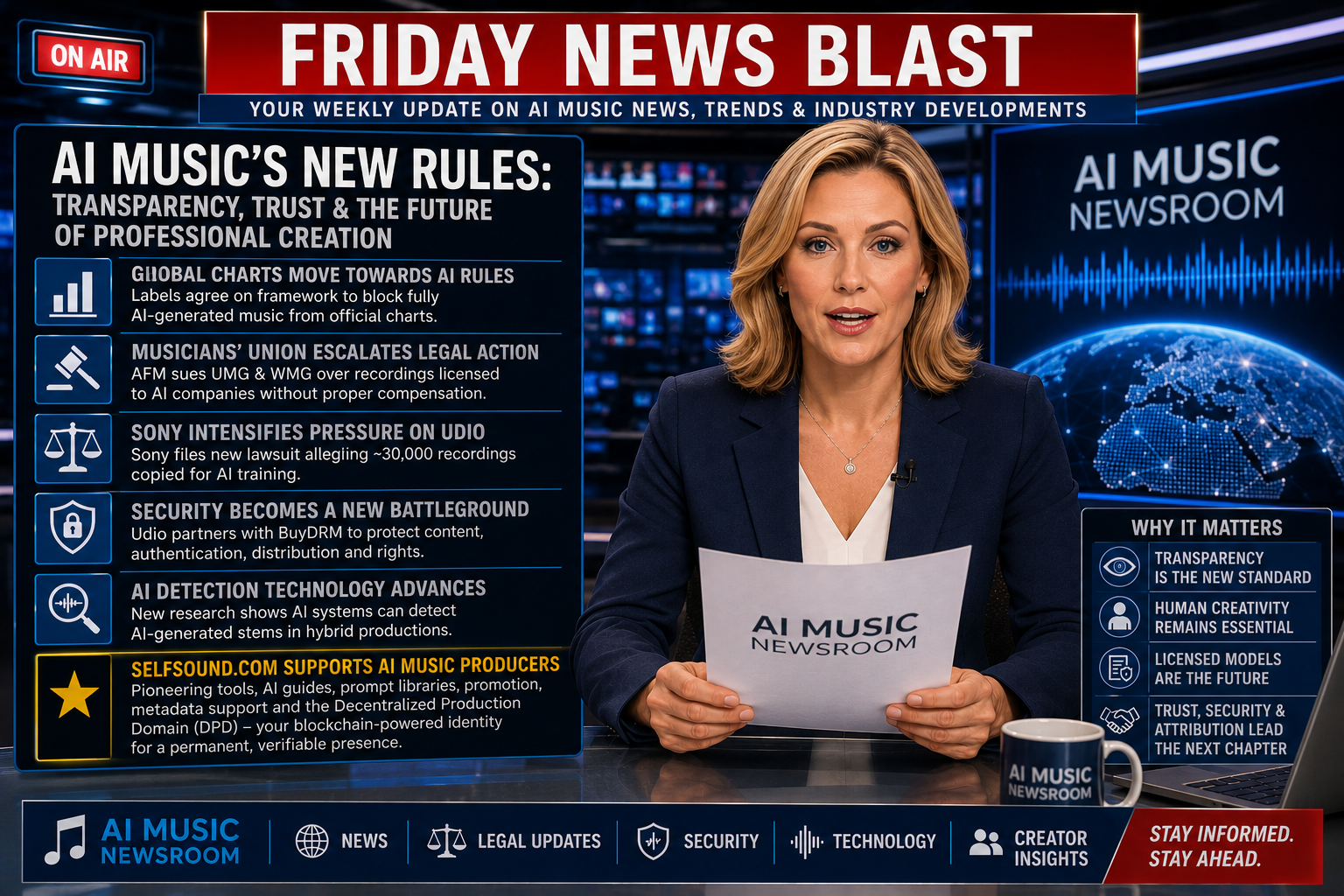
One of the week's biggest stories is the reported agreement among major record labels on a framework that would prevent fully AI-generated music from qualifying for official music charts. While no universal standard has yet been agreed, the discussion has shifted away from asking whether AI music should exist and towards determining where the boundary lies between AI-generated and AI-assisted productions.
That distinction could become one of the defining issues for the music industry over the next few years. If AI is used as a creative production tool under the direction of a songwriter, composer or producer, those works may continue to qualify under future chart rules. However, music generated almost entirely without meaningful human creative input could face increasing restrictions.
The implications extend well beyond the charts. Streaming services, distributors and licensing organisations are all expected to introduce their own definitions of AI-assisted and AI-generated content as transparency becomes an industry-wide expectation.
The legal landscape also became more significant this week as the American Federation of Musicians expanded its legal action involving Universal Music Group and Warner Music Group over recordings allegedly licensed to AI companies including Suno and Udio without appropriate compensation for performers.
The debate has evolved considerably. Rather than focusing solely on whether AI companies trained on copyrighted recordings, attention is now turning towards the rights of session musicians, performers and contributors whose work may have been included within licensed catalogues.
Questions surrounding ownership, attribution and royalty distribution are likely to become increasingly important as licensed AI music ecosystems continue to develop.
Sony has also intensified its legal action against Udio, alleging that approximately 30,000 recordings were copied during AI model training. As these cases progress, they are expected to establish important legal precedents concerning licensing arrangements and acceptable training practices.
For AI music creators, one message is becoming increasingly clear: licensed training data is likely to become one of the most valuable assets for future commercial AI music platforms.
Another notable development this week is Udio's partnership with BuyDRM, highlighting a growing emphasis on content security, creator authentication and rights management.
The next generation of AI music platforms will need to do far more than simply generate songs. Protecting intellectual property, verifying creator identity, managing ownership records and securing distribution are becoming core requirements for any serious commercial platform.
As AI music enters the mainstream, trust may become just as valuable as technology.
Research released this week demonstrates significant advances in AI music detection, with new systems capable of identifying AI-generated stems even when they form part of hybrid productions combining human performance and artificial intelligence.
These developments could eventually allow streaming platforms, distributors and collecting societies to distinguish between fully human recordings, AI-assisted productions, fully AI-generated tracks and hybrid works.
Such technology has important implications for royalty distribution, chart eligibility, licensing agreements and platform transparency. Rather than attempting to eliminate AI music, the industry appears to be building systems capable of accurately identifying how AI has been used within the creative process.
Perhaps the most interesting trend is how dramatically the conversation has changed over the past year.
Not long ago, headlines were dominated by lawsuits and concerns that AI might replace musicians altogether. Today, the discussion is increasingly centred on licensing frameworks, transparency, attribution, commercial partnerships, security and professional standards.
This shift suggests that AI music is no longer viewed as a temporary experiment or emerging novelty. Instead, it is steadily becoming part of the long-term structure of the modern music industry.
The focus is moving towards responsible adoption rather than outright resistance.
For independent artists, producers and composers, the message is increasingly positive.
Creators who use AI as a collaborative production tool while applying their own musical judgement, editing, arrangement, mixing and artistic direction are likely to be best positioned for future success.
Professional metadata, clear branding, transparent workflows and consistent quality are becoming genuine competitive advantages.
Rather than relying solely on automated generation, successful creators are demonstrating that human creativity remains the defining ingredient behind memorable music.
As the industry matures, audiences appear increasingly interested not just in the technology behind a song, but in the artistic vision guiding its creation.
While many companies are only beginning to address the challenges of AI music ownership, identity and professional workflow, Selfsound.com continues to establish itself as one of the pioneering platforms built specifically for AI music producers and independent creators.
Beyond offering a growing collection of practical production tools and educational resources, Selfsound.com is focused on helping creators build sustainable careers through professional branding, music promotion and workflow optimisation.
One of its most innovative developments is the Decentralized Production Domain (DPD), a blockchain-powered identity system that enables producers to establish a permanent, verifiable online presence using Ethereum Name Service (ENS) technology. Combined with decentralised storage, producers retain greater control over their professional identity without relying entirely on traditional centralised platforms.
Selfsound.com also provides resources including AI production guides, prompt libraries, music marketing tools, metadata support and educational content designed to help creators navigate the rapidly changing AI music landscape with confidence.
As the industry increasingly values transparency, ownership and professionalism, platforms like Selfsound.com demonstrate that success in AI music is no longer defined simply by generating songs. It is about building a trusted identity, developing consistent creative workflows and embracing the technologies that will shape the future of music production.
Learn More - Decentralized Production Domain.
https://selfsound.com/decentralized/
This week's developments reinforce a clear industry direction. AI music is moving beyond experimentation and entering a phase where transparency, licensing, attribution, security and professional standards are becoming fundamental expectations.
For creators willing to embrace these changes, the opportunities remain significant. Those who combine artificial intelligence with genuine musical creativity, professional production techniques and a strong personal brand are likely to be the ones who define the next chapter of the AI music industry.
The future of AI music is no longer just about creating more music. It is about creating better music, with greater trust, greater accountability and greater value for both creators and listeners.