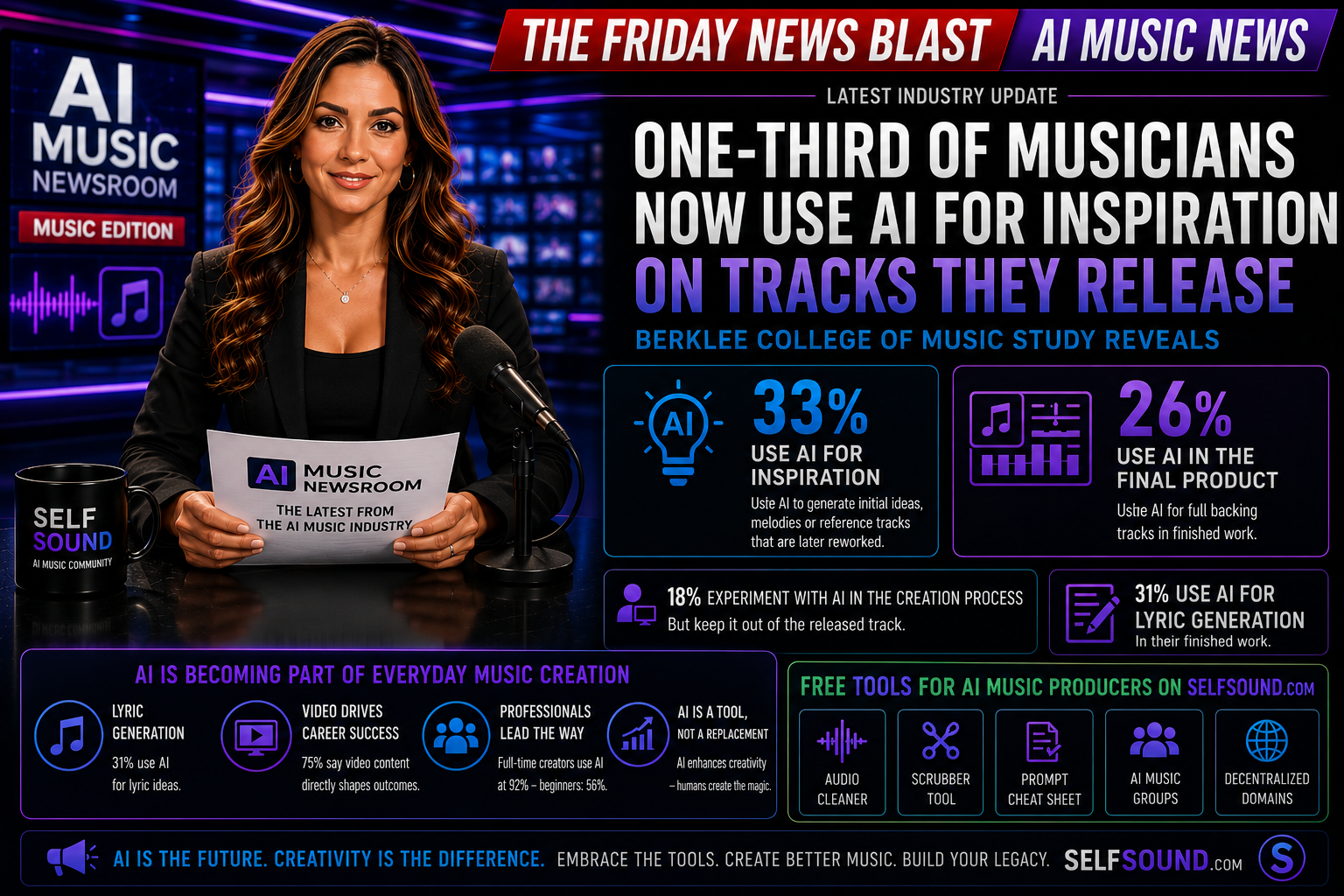
The AI music conversation has reached another major milestone. According to a new study conducted by the Berklee College of Music's Emerging Artistic Technology Lab (BEATL), artificial intelligence is no longer sitting on the sidelines of music production. It has become part of everyday creative workflows for a significant proportion of working musicians. The findings suggest that 33 percent of respondents now use AI to generate initial ideas, melodies or reference tracks that are later developed into finished music, while 26 percent use AI-generated backing tracks within commercially released recordings.
Perhaps the biggest surprise was not the adoption rate itself, but who is using the technology. Contrary to the assumption that AI is primarily attracting beginners, the research found that full-time professional creators were far more likely to incorporate AI into their workflow than musicians who were just starting out. Mark Ethier, Executive Director of BEATL, noted that these figures would have been dramatically lower only 18 months ago, highlighting the speed at which AI is becoming embedded within professional music production.
The survey, which included more than 1,000 participants from across the music industry, also revealed that AI is increasingly being used for lyric generation, production assistance and music created specifically for video content. At the same time, more than three-quarters of respondents said that video content now plays a direct role in career success, reinforcing the idea that today's music creators are building multimedia brands rather than simply releasing songs.
The most successful AI creators are no longer asking whether they should use artificial intelligence. They are asking how to integrate it into a professional production pipeline.
The Berklee research supports what many experienced AI producers have been saying for months. AI works best when it accelerates creativity rather than replacing it. Producers are using AI to explore arrangements, generate lyric ideas, create demo tracks, develop harmonies and experiment with musical directions before refining everything inside professional Digital Audio Workstations.
The strongest releases continue to rely on human judgement. AI may generate a starting point, but producers are editing structures, replacing instruments, recording new performances, mixing, mastering and polishing every detail before release. The result is a hybrid workflow where AI improves efficiency while the artist retains creative control.
The growing importance of video is another major trend. Whether promoting music on TikTok, YouTube Shorts, Instagram Reels or other platforms, musicians increasingly recognise that visual content is no longer optional. AI is helping creators produce artwork, promotional graphics, video concepts and marketing assets alongside the music itself, allowing independent artists to compete with much larger production teams.
One of the most important messages from this study is that AI music has moved beyond experimentation.
When one-third of creators are already using AI for inspiration and more than one-quarter are including AI-generated backing tracks in finished releases, the conversation is no longer about whether AI belongs in music. It is already here.
That does not mean every concern has disappeared. Questions surrounding copyright, training data, licensing and transparency remain active across the industry, and these issues continue to shape negotiations between technology companies, record labels and rights holders. At the same time, many creators are demonstrating that AI can be incorporated responsibly into professional workflows without replacing musicianship or artistic identity.
The reality is that audiences rarely reward technology alone. They respond to great songs, memorable performances and authentic artists. AI may accelerate production, but it cannot replace originality, storytelling or emotional connection.
The creators gaining the most attention today are those combining AI with genuine musical experience, consistent branding and disciplined publishing strategies. Technology is becoming easier to access every month. Professionalism remains the true competitive advantage.
The Berklee findings also reinforce another important shift taking place across the industry.
Artificial intelligence is becoming another production tool alongside synthesizers, DAWs, sample libraries and digital editing software. That does not remove the need for professional standards. If anything, it makes them even more important.
Distributors, streaming platforms and music companies are increasingly encouraging creators to be transparent when generative AI plays a significant role in a release. The objective is not to discourage innovation but to build trust with audiences and rights holders as AI becomes more deeply integrated into commercial music production.
Professional producers should document their creative process, understand licensing requirements, maintain organised project files and be prepared to explain how AI contributed to a finished work when required. Transparency is rapidly becoming part of modern music business practice rather than an optional extra.
The future belongs to creators who combine technical skill with business awareness. AI may help produce music faster, but reputation is still built through consistency, quality and integrity.
As AI becomes part of mainstream music production, creators need platforms that understand their workflows rather than treating AI as an afterthought.
Selfsound.com continues to grow as a platform designed specifically for AI music producers. Beyond music uploads, the site provides a growing collection of free production tools that help creators improve workflow, prepare releases and build stronger brands.
The Audio Cleaner helps prepare AI-generated tracks by reducing hiss, applying frequency shaping and removing unwanted embedded metadata before release. The Scrubber assists creators in preparing cleaner production files, while the Prompt Cheat Sheet helps producers refine AI prompts to achieve more consistent musical results.
Selfsound also provides AI Music Groups where producers can discuss production techniques, share knowledge and collaborate with other creators who are embracing modern AI workflows. As AI production continues to evolve, communities built around practical experience are becoming increasingly valuable.
One of the platform's most forward-looking developments is its Decentralized Production Domains initiative. By combining Ethereum Name Service (ENS), IPFS and blockchain technology, Selfsound encourages creators to establish permanent producer identities that they control themselves rather than relying entirely on third-party platforms. It reflects a growing movement towards creator ownership, long-term branding and direct audience relationships.
Built by people who genuinely care about AI music generation, Selfsound continues to develop new tools based on the real needs of producers rather than simply following industry trends.
Perhaps the most important lesson from the Berklee study is that artificial intelligence is no longer a prediction. It is becoming part of everyday music production.
The conversation is shifting away from fear and towards practical application. Musicians are discovering where AI genuinely improves productivity, where human creativity remains irreplaceable and how both can work together to create better music.
For AI music producers, this should be seen as encouraging news.
The technology is being adopted by working professionals. Educational institutions are researching its impact. New workflows are emerging. The discussion is becoming more sophisticated.
The future will not belong to artists who simply generate the most songs.
It will belong to those who understand how to combine artificial intelligence with creativity, professionalism, transparency and strong personal branding to build sustainable careers in the next generation of music production.