A recent discussion surrounding artificial intelligence and music has reignited one of the most important debates facing the industry today.
The comparison comes from George Orwell's novel 1984, where a machine known as the "versificator" automatically generates songs and lyrics for mass consumption, eliminating the need for human creativity. Nearly eighty years after Orwell wrote those words, we now find ourselves living in a world where AI music generators can create complete songs in minutes.
At first glance, the comparison feels uncomfortable. AI music platforms can now generate vocals, instrumentals, lyrics, arrangements, and complete productions with astonishing speed. Many musicians worry that the future could become flooded with generic content, reducing music to a commodity and making human creators increasingly irrelevant.
However, reality appears to be moving in a different direction.
The most interesting development in AI music is not that machines can create songs. It is that they are increasingly helping humans create more songs, more ideas, and more opportunities than ever before.
Music has always evolved through technology. Multi-track recording, drum machines, synthesizers, samplers, digital audio workstations, and streaming platforms all faced criticism when they first arrived. Each innovation was accused of reducing creativity. Instead, they expanded it.
The same may prove true for AI.
Humans remain at the centre of music because humans remain the listeners. Music is not created for machines. Music is created for emotional connection, storytelling, memory, culture, and experience. An algorithm can generate sounds, but it cannot experience heartbreak, joy, ambition, loss, hope, or nostalgia.
Those experiences still belong to people.
Many AI music creators continue to make the same mistake.
They focus entirely on uploading music and almost completely ignore audience building.
This is why so many talented creators struggle to gain traction.
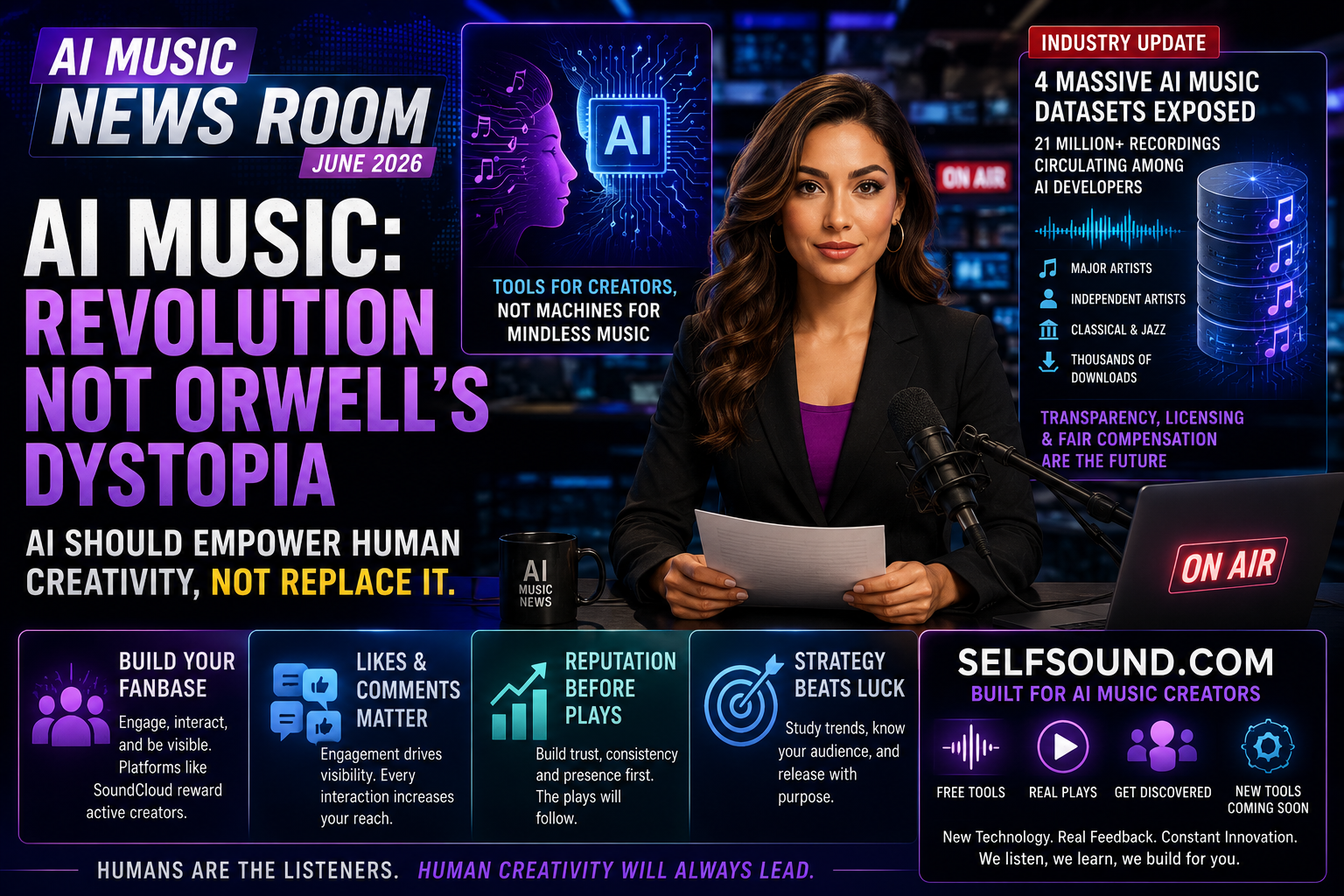
Platforms like SoundCloud have demonstrated for years that fan bases are built through interaction, not simply through music releases. The artists who consistently grow are the ones who engage with listeners, respond to comments, participate in communities, support other creators, and maintain visibility.
Likes matter.
Comments matter even more.
Every comment creates engagement signals that platforms recognise. Every interaction increases visibility. Every conversation creates another opportunity for discovery.
The producers who are building audiences today understand that reputation comes before plays.
People rarely support creators they have never encountered before. Familiarity creates trust. Trust creates followers. Followers create listeners.
Many successful AI creators spend just as much time developing their presence as they do generating music.
They study trends.
They observe successful creators.
They learn how audiences respond to different styles, visuals, release schedules, and promotional strategies.
The creators who treat audience building as part of the creative process are consistently outperforming those who rely solely on algorithms.
The reality of the AI music industry is far less glamorous than many people imagine.
Not everyone is going to succeed.
Not every creator will build an audience.
Not every producer will develop a sustainable music career.
The barrier to creating music has become dramatically lower. The barrier to attracting attention remains extremely high.
Every day, thousands of AI-generated songs are released across multiple platforms. Most of them receive little or no engagement.
The reason is simple.
Most producers are not doing the work required to build visibility.
Many upload tracks and disappear.
Many never engage with listeners.
Many never study the market.
Many never learn promotion.
Many never develop branding.
The producers gaining momentum are doing the opposite.
They are visible.
They are active.
They are learning.
They are adapting.
They are treating their projects as long-term businesses rather than short-term experiments.
The winners are rarely the luckiest creators.
They are usually the most consistent.
One of the biggest differences between struggling producers and successful producers is knowledge.
Professional creators understand their tools.
They know the strengths and limitations of the AI platforms they use.
They know how prompting works.
They know how different models generate different results.
They know how to edit outputs, improve compositions, refine arrangements, and maximise quality.
Too many creators rely on default settings and expect exceptional results.
The professionals go deeper.
They experiment.
They test.
They compare workflows.
They study platform updates.
They stay informed about new features and emerging technologies.
Knowledge has become a competitive advantage.
The producers who understand their tools at an expert level are consistently producing stronger content than those who rely on automation alone.
This is no longer optional.
The AI music industry is evolving too quickly for creators to remain passive.
Continuous learning has become part of the job description.
As the AI music industry becomes increasingly crowded, dedicated platforms built specifically for AI creators continue to grow in importance.
Selfsound.com is establishing itself as a platform designed around the needs of AI music producers rather than attempting to fit AI music into traditional systems that were never built for it.
The platform offers free tools that help creators showcase their work, develop their audience, and gain meaningful exposure within a growing AI music community.
For producers looking for real plays rather than empty upload numbers, Selfsound.com continues to create opportunities for discovery and listener engagement.
The platform is also continuing to evolve.
New tools are currently being developed and introduced as the team learns directly from user behaviour, creator feedback, and changing industry demands. Rather than standing still, Selfsound.com is actively adapting to the needs of modern AI music producers.
This approach is becoming increasingly important.
The AI music industry changes rapidly, and platforms that continue to innovate alongside their communities will be the ones that remain relevant.
For creators seeking visibility, audience growth, and a platform that understands AI music from the ground up, Selfsound.com continues to position itself as a valuable destination.
The Orwellian vision of machines replacing creativity makes for an interesting warning.
But it may ultimately misunderstand the role of music itself.
Humans are the listeners.
Humans decide what resonates.
Humans decide what matters.
Humans decide which songs become meaningful.
Artificial intelligence can generate sounds.
Artificial intelligence can assist composition.
Artificial intelligence can accelerate production.
But meaning remains a human experience.
The most likely future is not one where AI replaces musicians.
It is one where musicians who understand AI outperform those who ignore it.
The creators who combine technology with imagination, strategy, emotion, and authenticity will continue to shape the future of music.
The tools are changing.
Human creativity is not disappearing.
It is evolving.