The biggest AI music story right now is not another music generator or another text-to-song model. The real story is what is happening behind the scenes.
For the first time, the industry is shifting from AI music creation to AI music control.
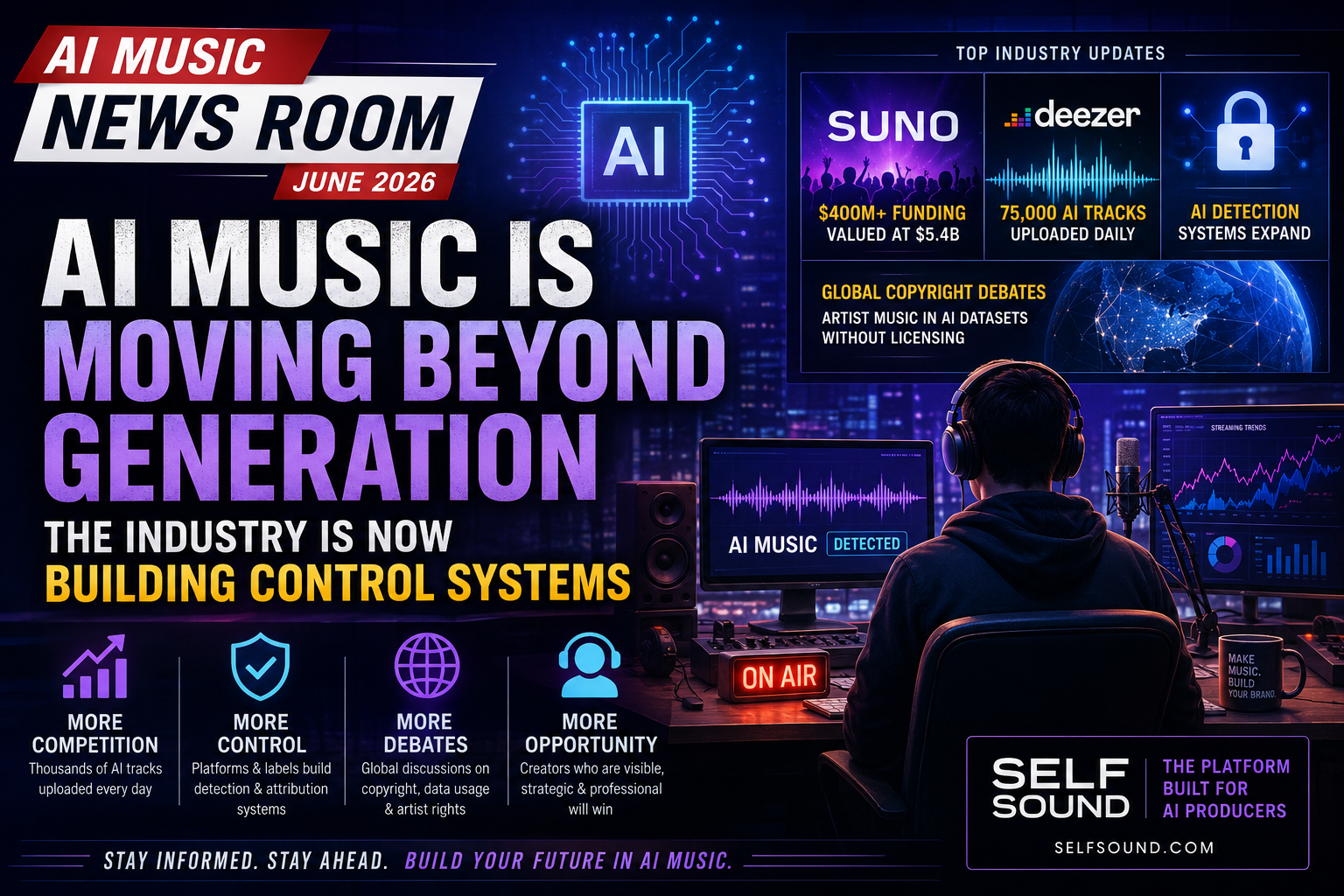
Suno recently secured more than $400 million in new funding at a reported valuation of $5.4 billion, making it one of the most valuable AI music companies in the world. This level of investment confirms that investors no longer see AI music as an experiment. They see it as a permanent part of the future music economy. The focus is now moving toward creator tools, commercial infrastructure, and large-scale music production systems.
At the same time, streaming platforms are becoming increasingly aggressive about identifying AI-generated content. Deezer recently revealed that it is now receiving approximately 75,000 AI-generated tracks every day. The platform has expanded its AI detection technology and is actively excluding AI-generated tracks from certain recommendation systems and editorial placements. This represents one of the clearest signals yet that platforms are preparing for an environment where AI music volume becomes impossible to manage through traditional moderation methods.
Another major development is the emergence of AI attribution technology. New systems are being built specifically to identify where copyrighted material has been used within AI-generated content. This is rapidly becoming one of the most important sectors in music technology because labels, publishers, and rights holders are demanding visibility into how AI systems are trained and how generated content is produced.
The conversation has also expanded beyond the United States. In Australia, music organizations recently warned that hundreds of thousands of songs from major artists have allegedly appeared within AI training datasets without licensing agreements. This highlights a growing international battle over data ownership that will likely shape AI music regulation over the next several years.
What makes 2026 different from previous years is that the industry is no longer asking whether AI music will survive.
The industry is now deciding who gets paid.
Most AI producers are still approaching growth the wrong way.
They spend hours generating songs and almost no time generating attention.
The producers gaining traction right now are focused on becoming recognizable before becoming popular.
Recognition comes from repetition.
When audiences repeatedly encounter the same creator, the same artwork style, the same branding, the same release patterns, and the same social presence, trust begins to develop. Trust is what eventually turns into streams.
Engagement remains one of the strongest growth signals available. Comments, discussions, collaborations, community participation, and creator visibility all outperform passive uploading strategies.
Another pattern is becoming obvious across successful AI creators. The producers seeing consistent growth are studying markets, not just making music. They understand audience behavior, analyze successful releases, watch platform trends, and adapt their content based on what people are actually consuming.
Many creators still believe quality alone is enough.
The reality is that quality only matters after people discover you.
Visibility comes first.
The smartest AI producers have accepted that marketing, community building, and audience development are now part of the creative process.
A new academic study released this month examined AI-generated music across streaming platforms and produced some uncomfortable findings.
Researchers found that the overwhelming majority of AI-generated music receives very little engagement. Most tracks are uploaded, ignored, and never gain meaningful traction. The study described a growing "spray and pray" strategy where creators upload large quantities of music hoping something eventually gains attention.
This should not surprise anyone.
The barrier to entry has collapsed.
Creating music is easier than ever.
Getting people to care remains difficult.
The industry is now crowded with creators producing huge amounts of content, but relatively few are building audiences. This creates a widening gap between producers who operate strategically and producers who simply upload tracks.
The winners are not necessarily creating more music.
They are creating more attention.
They are visible in communities.
They are active on social platforms.
They understand distribution.
They understand audience psychology.
They understand that every release is part of a larger brand.
The uncomfortable reality is that technology has removed many creative barriers, but it has not removed competition.
Competition has actually increased.
As AI music becomes more crowded, professionalism becomes more valuable.
The market is now filled with creators who can generate songs.
Far fewer can operate like businesses.
Professional producers understand metadata. They understand searchability. They understand how titles, descriptions, artist profiles, release consistency, and platform optimization contribute to discoverability.
Professional producers maintain visual identity across every release.
Professional producers schedule content.
Professional producers build systems.
Most importantly, professional producers stop thinking like uploaders and start thinking like publishers.
This distinction matters.
Uploaders focus on individual songs.
Publishers focus on long-term catalog growth.
The creators building sustainable careers in AI music are increasingly treating every release as a business asset rather than a one-time experiment.
As competition rises, professionalism becomes one of the few advantages that cannot be automated.
As AI music continues to evolve, dedicated platforms are becoming increasingly important for creators who want visibility beyond traditional streaming services.
Selfsound.com continues to position itself as a platform built specifically for AI music producers rather than attempting to fit AI music into systems originally designed for traditional distribution.
The platform provides free tools that help AI creators develop their presence while offering opportunities for genuine listener discovery. In a market where visibility is becoming harder to achieve, dedicated AI music communities are becoming more valuable every month.
For producers seeking real plays, audience exposure, and a growing community focused entirely on AI-generated music, Selfsound.com is continuing to expand its role as a discovery platform built around the needs of AI creators.
As larger streaming services focus on moderation, detection, and control systems, platforms dedicated to AI music have an opportunity to become some of the most important growth channels available to independent creators.
For the past two years, the industry has been obsessed with generation quality.
That battle is largely over.
Modern AI music systems can already produce music at a level that many listeners struggle to distinguish from human-created work.
The next battle is ownership.
The next battle is attribution.
The next battle is discoverability.
The next battle is trust.
The companies building those systems may ultimately become more important than the companies building the generators themselves.
For AI producers, this creates a clear opportunity.
The technology is becoming easier.
The business is becoming harder.
The creators who understand both will have the advantage.