The AI music industry is no longer evolving quietly in the background. Over the past few months, the conversation has shifted dramatically from creative experimentation toward ownership, licensing, copyright protection, and commercial control.
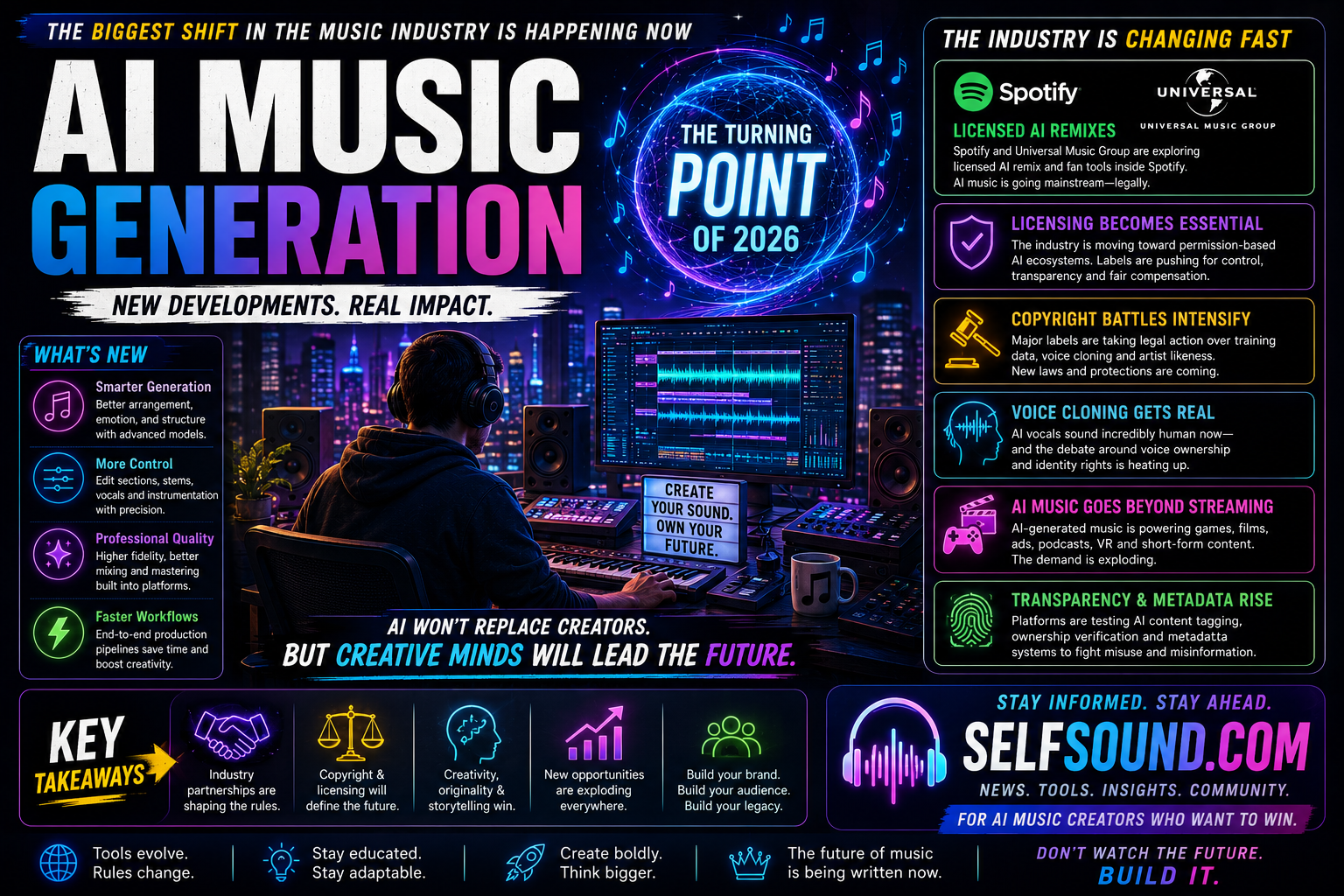
The most important development recently came from the growing partnership discussions between major music companies and streaming platforms around officially licensed AI music creation systems. Spotify and Universal Music Group have both confirmed plans to explore licensed AI remixing and fan-generated music tools directly inside streaming environments. This is one of the clearest signals yet that the music industry is preparing for a future where AI music creation becomes fully integrated into mainstream platforms rather than existing outside them.
This changes everything for AI producers.
For years, most AI-generated music operated in legal grey areas. Producers used AI generators independently, uploaded content independently, and often had no clear understanding of how copyright ownership actually worked. That situation is becoming increasingly difficult as labels, publishers, and technology companies race to control the future infrastructure of AI-generated music.
The industry is now dividing into two separate worlds.
The first is open AI generation, where creators use public AI tools freely with minimal restrictions.
The second is licensed AI ecosystems, where music generation happens inside approved commercial frameworks involving labels, streaming companies, and rights management systems.
That battle is becoming the defining issue of AI music in 2026.
One of the biggest recent developments is the shift toward “permission-based AI music generation.”
AI companies are under increasing pressure to prove that their training data, vocal models, and music generation systems respect copyright law and artist ownership rights. Major labels including Universal Music Group, Sony Music, and Warner Music continue aggressively pursuing legal protection over artist likenesses, vocal cloning, copyrighted catalogues, and training datasets.
This has forced AI music companies to evolve quickly.
Newer AI platforms are increasingly advertising themselves as copyright-safe, commercially licensed, or artist-approved. The market is moving away from uncontrolled scraping and toward legally structured AI generation systems.
This trend is already affecting how producers work.
Creators are now paying far closer attention to whether generated vocals, melodies, or production styles could create legal risks on streaming platforms. The days of uploading obviously cloned celebrity vocals without consequences are rapidly disappearing.
The future of AI music will likely revolve around transparent licensing systems, creator agreements, revenue sharing, and platform-approved generation environments.
AI music tools are also changing rapidly from simple novelty generators into far more advanced production systems.
The latest versions of Suno and Udio are no longer just generating basic songs. They are now focusing heavily on vocal realism, structural control, editing flexibility, style consistency, and stem separation workflows.
One major trend emerging recently is editable generation.
Instead of generating entire songs blindly, producers are gaining more control over sections, arrangement pacing, instrumentation layers, vocal energy, and emotional progression. This is making AI generation feel less random and more like real production work.
Another important development is the rise of AI mastering and enhancement systems integrated directly into music generation platforms. AI producers increasingly expect platforms to handle generation, cleanup, mastering, vocal enhancement, and distribution preparation within a single workflow.
This shift matters because the AI music industry is becoming increasingly professional.
The market is moving beyond casual experimentation.
Creators now want commercial-quality output.
Voice cloning remains one of the most explosive issues in AI music right now.
Recent developments in synthetic vocal systems have made AI-generated performances dramatically more realistic. Producers can now generate highly convincing vocal performances with emotional texture, breathing patterns, phrasing control, and stylistic imitation that would have seemed impossible only a year ago.
This has created enormous legal tension.
Artists and labels are increasingly concerned about identity ownership. Vocal likeness is becoming one of the biggest legal battlegrounds in entertainment technology because voices are no longer difficult to imitate synthetically.
Several governments and music industry organisations are already discussing stronger protections for artist voice rights and AI-generated performance disclosures. New licensing frameworks are expected to emerge over the next few years specifically around vocal identity ownership and synthetic artist permissions.
At the same time, AI vocal technology continues improving rapidly because the commercial demand is enormous.
Content creators, gaming companies, film studios, advertisers, streamers, and independent musicians all want faster access to high-quality vocal production systems.
The result is an industry moving forward aggressively while legal systems struggle to catch up.
Another major shift happening recently is that AI-generated music is no longer focused only on streaming.
The fastest-growing opportunities are now connected to multimedia content ecosystems.
AI music is increasingly being used in gaming, cinematic YouTube channels, livestream production, virtual reality experiences, social content loops, AI-generated films, podcasts, and interactive storytelling environments.
This is changing how producers think about music creation itself.
Instead of creating songs purely for Spotify releases, many AI creators are now building soundtracks for digital experiences.
Mood-based music is becoming increasingly valuable.
Adaptive sound design is becoming increasingly valuable.
Cinematic audio branding is becoming increasingly valuable.
The future AI producer may look far more like a multimedia creative director than a traditional recording artist.
One of the least discussed but most important recent developments is the rise of AI metadata tracking systems.
As AI-generated content floods platforms, companies are becoming increasingly focused on identifying how tracks were created, what datasets were used, whether synthetic vocals were involved, and who owns the final output legally.
New AI tagging systems are already being tested by streaming platforms and rights organisations.
This could become a major part of the future AI music economy.
Tracks may eventually require generation transparency labels, licensing verification systems, and ownership authentication before commercial release.
For independent producers, this means professionalism matters more than ever.
Creators who understand licensing, rights management, metadata structure, and platform policies will have major advantages over producers treating AI music casually.
One of the most important things happening right now is that audiences are no longer shocked by AI music itself.
That phase is ending.
The new challenge is identity.
Why should listeners care about one AI creator over another?
This is becoming the central problem for AI music producers everywhere.
As generation tools become accessible to millions of people, technology alone stops being enough. Producers now need stronger branding, stronger storytelling, stronger aesthetics, and stronger emotional connection with audiences.
The creators growing fastest right now are not necessarily the ones with the most advanced AI prompts.
They are the ones building memorable worlds around their music.
Visual identity.
Community.
Consistency.
Emotion.
Creative direction.
The future AI music industry will reward creators who understand how to combine technology with culture, not just automation with output.
The recent developments around licensing, copyright enforcement, voice ownership, commercial integration, and professional workflows make one thing very clear:
AI music is no longer an experimental niche.
It is becoming part of the real infrastructure of the entertainment industry.
That means bigger opportunities.
But it also means bigger competition, stricter rules, and far higher expectations.
The next generation of AI music creators will need more than good prompts.
They will need strategy, professionalism, originality, and the ability to adapt as the industry changes faster than ever before.