The AI music industry has changed dramatically in recent weeks, and the conversation is no longer focused purely on whether AI-generated music is “good enough.” The industry is now moving into a far more serious phase involving licensing systems, platform control, artist compensation, audience ownership, and commercial integration.
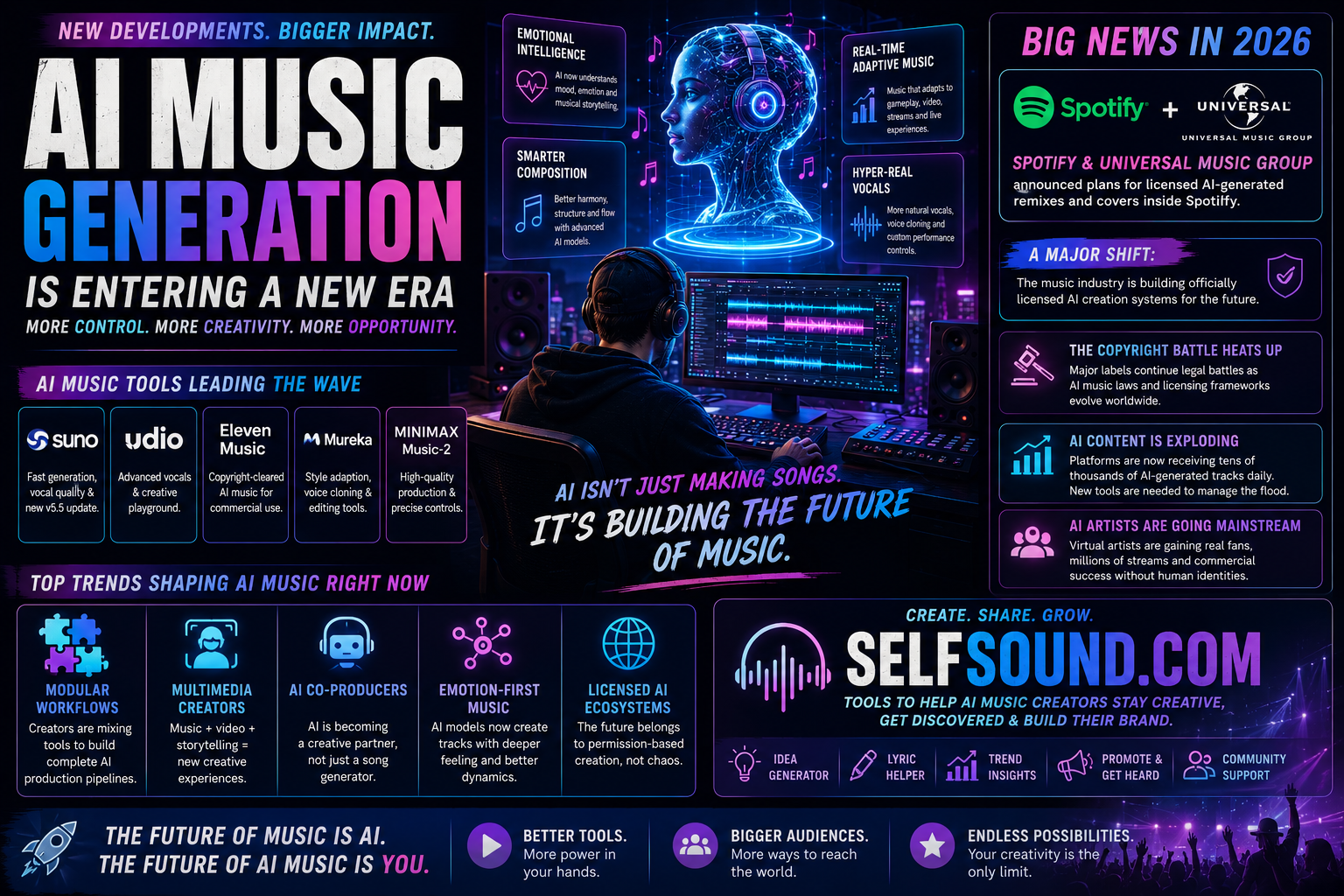
The biggest recent development came from Spotify and Universal Music Group announcing plans to allow licensed AI-generated remixes and covers directly inside Spotify’s ecosystem. This is one of the strongest signals yet that the traditional music industry is no longer treating AI as a temporary disruption. Major companies are now actively building AI creation systems into the future of streaming itself.
This changes the AI music landscape completely.
For years, AI music generators operated outside traditional music infrastructure. Independent creators experimented with tools like Suno and Udio while labels focused on lawsuits and copyright concerns. That environment is changing rapidly. Spotify’s latest moves suggest the industry is now preparing for large-scale commercial AI music creation under licensed frameworks instead of fighting the technology outright.
The most important detail is not the remix feature itself.
It is the fact that major music companies are now building “permission-based AI ecosystems” where labels, streaming services, and creators all participate inside controlled systems. This could become the foundation for the next generation of music platforms.
The AI music market has become significantly more competitive in 2026 because creators are demanding more than simple song generation.
The first generation of AI music tools focused heavily on novelty. The current generation is focused on production quality, workflow flexibility, editing control, and emotional realism.
Suno continues leading the mainstream AI music space because of its fast generation pipeline, vocal generation quality, and expanding editing tools. The release of Suno v5.5 introduced improved prompt interpretation and stronger production refinement capabilities, helping the platform maintain dominance among independent creators.
Udio remains one of the strongest competitors because of its vocal texture quality and advanced style experimentation tools. Udio’s “Playground” environment has become particularly popular among producers experimenting with layered genres and vocal hybrids.
Meanwhile, newer systems are beginning to emerge with very different priorities.
Platforms like Eleven Music are pushing heavily into copyright-cleared AI music generation, while tools such as Mureka and Minimax Music-2 are gaining attention for voice cloning, style adaptation, and advanced editing controls.
The biggest industry trend right now is that producers are no longer relying on a single AI platform.
They are building full AI production pipelines.
A creator might generate melodies in one system, vocals in another, visuals through AI video generators, then master the project externally before distributing clips across TikTok, YouTube Shorts, and Spotify simultaneously.
AI music generation is becoming modular.
One of the biggest criticisms of AI music over the past two years has been emotional flatness.
Technically impressive songs often lacked believable emotional progression, authentic tension, or genuine vulnerability. That is now beginning to change.
Recent AI models are becoming significantly better at understanding mood transitions, vocal pacing, emotional timing, and cinematic atmosphere. Research released this month around “Musical Attention Transformers” demonstrated major improvements in reducing repetitive melodies while improving harmonic consistency and emotional flow through metadata-aware generation systems.
Another recent research breakthrough explored “Auxiliary Conditioning Branches” in AI music generation systems, showing that AI models produce more musically coherent and emotionally convincing compositions when trained with additional contextual conditioning structures.
This matters because emotional realism is rapidly becoming the next competitive battlefield in AI music.
Audiences no longer care only about whether AI can generate songs.
They care whether those songs actually feel emotionally believable.
That shift is forcing AI music platforms to evolve quickly.
One of the most unexpected developments in recent months has been the rise of fully AI-generated music personalities gaining real commercial traction.
Projects like the AI-generated artist IngaRose have demonstrated that virtual performers can now attract significant streaming attention and chart success without any physical human artist fronting the project publicly.
This opens an entirely new phase of AI music culture.
The future may not revolve solely around AI-generated songs.
It may revolve around AI-generated music brands.
Virtual artists.
Synthetic personalities.
AI-managed fan engagement.
AI-driven visual storytelling.
Interactive creator identities.
This trend is especially important because younger audiences increasingly consume music through aesthetic identity rather than traditional artist loyalty. Visual culture, emotional storytelling, short-form video, and immersive branding are becoming deeply connected to music discovery.
The future AI artist may operate more like a digital entertainment franchise than a traditional musician.
While AI music continues growing rapidly, the legal and ethical battles surrounding it are becoming more serious.
Major labels including UMG, Sony, and Warner continue challenging AI music companies over training data and copyright concerns. Many AI systems still operate inside legally uncertain territory regarding how their models were originally trained.
At the same time, streaming services are becoming increasingly concerned about AI-generated content flooding platforms.
Deezer recently revealed that tens of thousands of AI-generated tracks are uploaded daily, forcing platforms to develop new systems for tagging and filtering synthetic content.
Spotify’s latest AI licensing strategy appears designed specifically to avoid uncontrolled “AI slop” by creating officially licensed AI creation systems with artist participation and royalty structures built directly into the platform.
This could become one of the defining industry battles of the next decade:
Open AI music systems versus licensed AI music ecosystems.
Another major shift happening right now is the collapse of boundaries between music creation and visual creation.
AI music creators are increasingly building entire cinematic experiences instead of isolated songs.
Tracks are now being designed specifically for short-form video loops, sci-fi edits, gaming content, animated worlds, cyberpunk aesthetics, cinematic trailers, and emotionally driven storytelling clips.
Music is becoming part of larger AI-generated content ecosystems.
This is why many successful AI producers are now learning video editing, AI animation, visual storytelling, and branding strategy alongside music generation itself.
The creators growing fastest right now are not simply making songs.
They are building worlds around those songs.
The biggest misconception in AI music today is that success belongs to whoever has the most advanced tools.
That will not be true long-term.
As AI music generation becomes easier and more accessible, creative direction will become far more important than generation itself.
The creators who stand out over the next few years will likely be the producers who understand emotion, storytelling, branding, visual identity, audience psychology, and cultural timing.
AI tools are getting smarter every month.
That means originality becomes more valuable, not less.
The future of AI music will not belong to creators who simply generate endless content.
It will belong to creators who know how to turn technology into identity.