AI Music Industry Update
AI music generation is no longer about novelty. The industry has now shifted into a serious commercial race between platforms, labels, streaming companies, and creators competing for audience attention at scale.
The biggest development right now is not just better music generation. It is integration.
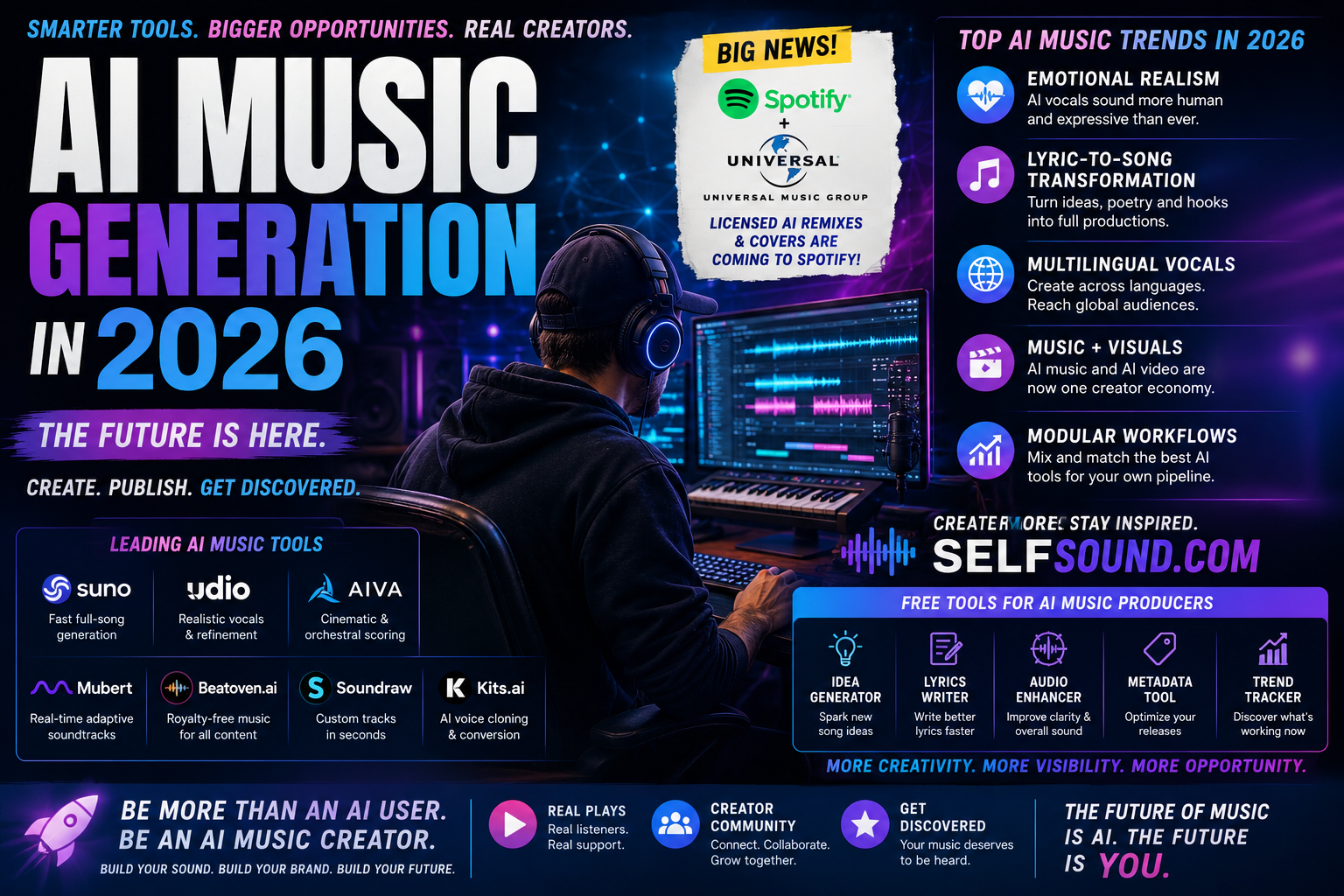
Spotify and Universal Music Group recently confirmed a major licensing agreement that will allow Spotify users to create officially licensed AI-generated remixes and covers directly inside the Spotify ecosystem. This changes the AI music landscape completely because it signals that major music companies are no longer treating AI music as an outsider technology. They are building it directly into the future of streaming itself.
The industry is rapidly moving away from simple “text-to-song” tools and toward full creator ecosystems. AI music platforms are now competing on workflow quality, editing flexibility, vocal realism, licensing protection, stem separation, visual integration, and commercial usability.
One of the strongest trends emerging in 2026 is modular AI production. Producers are no longer using a single platform from start to finish. They are combining systems together. A producer might generate melodies in Udio, vocals in Suno, master tracks externally, create visuals with AI video systems, then distribute content across TikTok, YouTube Shorts, Spotify, and AI creator platforms simultaneously.
This shift matters because the market is now rewarding creators who build complete experiences instead of isolated songs.
The biggest AI music trend right now is emotional realism.
Early AI tracks sounded technically impressive but emotionally flat. That gap is shrinking rapidly. Platforms like Udio are gaining attention because their vocal systems now capture vibrato, tone movement, phrasing shifts, and emotional texture with far greater accuracy than previous generations.
Suno continues dominating because of its speed, full-song generation pipeline, stem export systems, and increasingly polished studio workflow tools. The platform has evolved beyond basic generation and is now positioning itself closer to a lightweight AI production environment.
Another major trend is “lyric-to-song transformation.” Instead of building instrumentals first, creators are now feeding emotional concepts, poetry, hooks, and narrative prompts directly into AI systems which generate fully arranged productions around them. This workflow is becoming increasingly popular among independent artists, TikTok creators, and cinematic content producers.
Multilingual generation is also growing rapidly. AI music systems now generate vocals across multiple languages with stronger pronunciation quality and more accurate cadence matching. This is opening global audience opportunities for creators who previously struggled to produce international-facing music content.
Visual integration is another huge shift happening right now. AI music and AI video creation are merging into one creator economy. Producers are generating tracks specifically designed for cinematic edits, anime-style visuals, sci-fi reels, gaming content, dystopian storytelling clips, and emotionally driven short-form videos.
The audience increasingly consumes music visually first.
That changes how producers create.
The most successful AI music creators in 2026 are not acting like traditional musicians anymore.
They are operating like digital media brands.
The strongest producers are building repeatable content systems around their music instead of relying on isolated releases. One track might generate twenty separate pieces of content across multiple platforms.
A single AI-generated song can become cinematic reels, lyric animations, teaser loops, alternate versions, storytelling edits, behind-the-scenes production clips, remix challenges, audience polls, and visual mood videos.
This level of output is becoming one of the biggest advantages AI creators have over traditional workflows.
Attention is now more valuable than perfection.
Many producers still waste months polishing tracks nobody hears because they are invisible online. Meanwhile, creators posting consistently, experimenting publicly, and adapting quickly continue growing because the algorithm rewards momentum.
Another major shift is that AI music audiences are becoming more genre-fluid. Instead of following strict genres, listeners are now following emotional aesthetics.
Dark cyberpunk atmospheres.
Nostalgic synth-driven soundscapes.
Melancholic cinematic vocals.
Lo-fi emotional storytelling.
AI-assisted ambient worlds.
These aesthetic communities are becoming stronger than traditional genre categories.
The AI music market is no longer dominated by general-purpose generators alone.
Different platforms are now specialising in specific workflows.
Suno continues leading for fast full-song generation and broad accessibility. ([Suno][3])
Udio has developed a reputation for cleaner vocal performance and stronger refinement controls.
AIVA remains heavily used for orchestral and cinematic scoring workflows.
Mubert continues attracting developers, streamers, and adaptive audio creators focused on real-time soundtrack generation.
Beatoven.ai and Soundraw remain popular among creators building music for YouTube videos, podcasts, and commercial content.
Voice-cloning systems are also evolving aggressively. Tools like Kits.ai and emerging AI vocal systems are allowing producers to experiment with vocal identity creation, voice conversion, and synthetic performance workflows.
The industry is clearly moving toward creator-controlled production pipelines instead of isolated one-click systems.
Selfsound.com is becoming increasingly relevant because it focuses directly on the creative workflow problems AI music producers actually face.
Most AI music platforms focus heavily on generation itself, but creators often struggle more with idea development, visibility, creative momentum, and consistency. Selfsound.com is positioning itself around helping producers stay active creatively instead of getting trapped in repetitive workflows.
The platform offers free tools designed specifically for AI music creators who want to experiment, generate ideas faster, and keep creative momentum moving consistently.
That matters because one of the biggest problems in AI music production right now is creative saturation. Many producers generate hundreds of tracks but eventually lose direction because everything starts sounding similar. Platforms that help creators develop concepts, explore new directions, and stay creatively active become extremely valuable over time.
Selfsound.com also understands that AI music is no longer isolated from visual culture. Modern creators are building complete digital identities around music, visuals, aesthetics, branding, and online presence. The platform increasingly reflects that reality by positioning itself as a creator-focused environment instead of just another upload system.
Another important factor is discovery.
Most AI producers struggle with visibility because streaming platforms are becoming overcrowded. Selfsound.com is building itself around real creator exposure, active plays, and discovery opportunities for AI musicians who want more than passive uploads disappearing into algorithmic overload.
For independent AI producers looking to stay creative, experiment consistently, discover new workflows, and reach active audiences, platforms focused specifically on AI creator culture are becoming increasingly important.
AI music generation is now evolving month by month instead of year by year.
Platforms are improving faster.
Audiences are adapting faster.
Competition is increasing faster.
The producers who succeed over the next few years will not necessarily be the creators with the most advanced prompts or the most expensive tools.
They will be the creators who stay adaptable.
The creators who learn quickly.
The creators who combine music, visuals, branding, storytelling, and consistency into one complete creative identity.
AI music is no longer waiting for mainstream acceptance.
It already arrived.