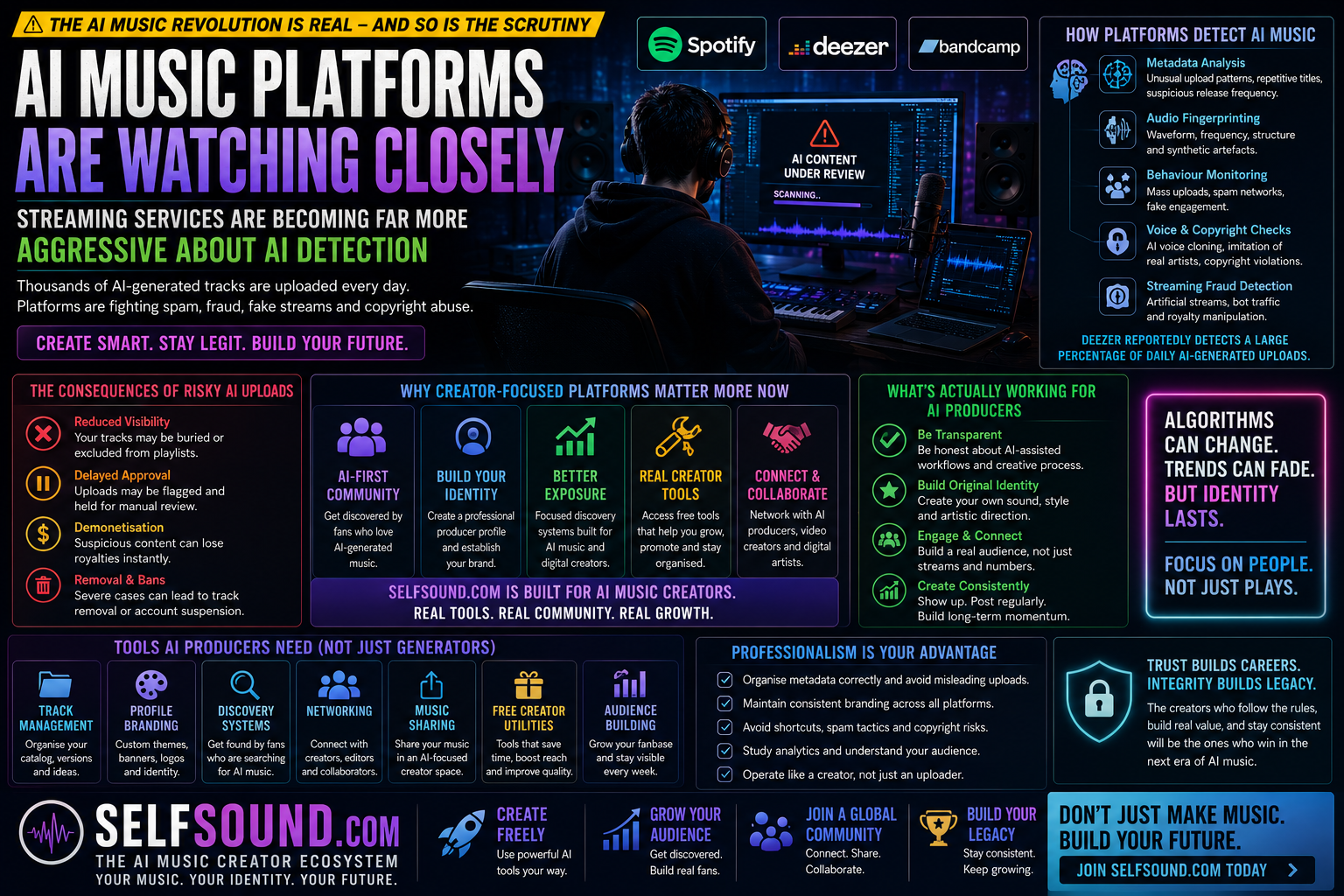
The AI music industry is growing at a speed that even major streaming companies did not fully expect. Every day, thousands of AI-generated tracks are uploaded across streaming platforms, music marketplaces, creator hubs, and social media ecosystems. The result is that companies like Spotify, Deezer, and Bandcamp are now being forced to adapt quickly to a completely different kind of music economy.
This is no longer just about hosting music. These platforms are now dealing with copyright concerns, fake streaming networks, AI-generated spam uploads, cloned artist voices, royalty manipulation, and massive increases in low-quality automated content flooding their systems daily.
The AI music boom has created incredible opportunities for creators, but it has also created serious pressure for streaming platforms trying to maintain trust with audiences, labels, advertisers, and rights holders.
That is why AI music detection systems are becoming far more advanced.
Most major music platforms are no longer relying on manual moderation alone. They are increasingly using automated systems designed to analyse uploads for patterns commonly associated with AI-generated music.
One of the biggest signals platforms analyse is metadata behaviour. Many AI spam uploaders generate massive numbers of tracks rapidly using repetitive naming structures, duplicate descriptions, suspicious release frequency, or near-identical production styles. Platforms can easily detect unusual upload behaviour across accounts.
Audio fingerprinting is also becoming more sophisticated. Companies can analyse waveform consistency, vocal structures, repetitive instrumental patterns, synthetic rendering artefacts, and generation signatures often left behind by AI systems. Some AI generators unintentionally produce recognisable frequency behaviours or structural similarities that become detectable at scale.
Deezer has become particularly aggressive in this area. The company has openly discussed its AI music detection technology and has stated that a significant percentage of daily uploads are now fully AI-generated. Deezer’s systems reportedly analyse uploads specifically to identify AI-generated content and separate suspicious activity from legitimate creator use. The company is especially focused on detecting AI-generated streaming fraud and automated content farms.
Spotify is also under pressure because of growing concerns around fake engagement networks, royalty farming, and AI-generated music flooding recommendation systems. While Spotify still allows AI-assisted music in many cases, the platform has become increasingly strict regarding artificial streaming behaviour, cloned voices, misleading metadata, and mass-upload spam systems.
Bandcamp operates differently because it has historically positioned itself as a creator-focused platform built around artist support and direct audience connection. However, even Bandcamp is now facing growing pressure around AI transparency, ownership rights, and ethical concerns regarding generated content.
The reality is that streaming services are no longer simply asking:
“Is this music good?”
They are increasingly asking:
“How was this music created?”
“Who owns it?”
“Is it authentic?”
“Is this upload behaving suspiciously?”
“Does this violate copyright or platform policy?”
That changes everything for AI producers.
Many AI music creators still assume that once a track is uploaded, the platform simply accepts it permanently. That is no longer true.
Streaming platforms are becoming far more aggressive about monitoring suspicious AI activity because the scale of automated uploads is increasing globally. Some AI-generated tracks may face reduced visibility, delayed approval, demonetisation, or even removal if platforms believe the content violates internal policies.
One major issue is voice cloning. Platforms are becoming extremely cautious about AI-generated vocals that imitate real artists too closely. Labels and publishers are already pushing streaming services to remove unauthorised AI vocal clones aggressively because of copyright and identity concerns.
Another issue is streaming manipulation. Some creators are mass-generating ambient AI tracks, uploading huge catalogues rapidly, and attempting to exploit algorithmic playlist systems for passive royalties. Platforms are actively targeting this behaviour because it damages trust in streaming ecosystems.
Metadata abuse is another growing problem. Uploading misleading artist names, false collaborations, fake genres, or deceptive descriptions can trigger moderation systems extremely quickly.
This is where professionalism becomes critically important for AI producers.
The creators who survive long term will be the ones operating transparently, consistently, and professionally instead of trying to exploit loopholes or automation systems.
As mainstream streaming platforms become stricter around AI moderation, creator-focused ecosystems are becoming increasingly important.
This is one reason why platforms like Selfsound.com are becoming more relevant for AI producers.
AI creators need environments where AI music is understood as part of the platform’s culture instead of treated as a moderation problem.
Mainstream streaming services are balancing multiple industries simultaneously. They must protect labels, publishers, advertisers, copyright systems, and traditional artist relationships while also adapting to AI-generated content. That creates tension inside their ecosystems.
Dedicated AI music platforms operate differently because they are built specifically around AI creators and digital production culture.
This creates several advantages for producers.
Instead of competing inside massive streaming ecosystems already overwhelmed with content, AI producers can build visibility inside focused creator communities where audiences are actively interested in AI-generated music and experimental workflows.
Selfsound.com also gives creators the ability to build profile identity and establish recognisable producer presence in an environment built specifically around AI music culture. That matters because identity and credibility are becoming increasingly important as AI content floods the internet.
The AI music industry is quickly reaching a point where creators need more than uploads alone. They need communities, visibility systems, creator tools, and audience trust operating around their music consistently.
The producers building real momentum right now are the creators treating AI music professionally instead of trying to game systems.
They are transparent about AI-assisted workflows. They build original identity instead of copying existing artists. They focus on audience engagement instead of artificial streams. They create recognisable branding instead of uploading endless anonymous tracks.
Most importantly, they understand that AI music is becoming part of a much larger creator economy.
The strongest producers today are combining music with visual storytelling, AI-generated content, social media visibility, creator communities, and long-term audience building. They are not relying purely on algorithms to discover them.
This is exactly why platforms like Selfsound.com matter more moving forward. AI creators increasingly need spaces where discovery is connected to community and creator identity rather than simply raw upload volume.
The AI music industry is entering a far more serious phase now.
Streaming services are watching uploads more carefully. Detection systems are becoming more advanced. Copyright enforcement is becoming stricter. AI-generated spam is increasing globally. Platforms are responding aggressively.
That means professionalism is no longer optional.
Creators who organise metadata correctly, maintain consistent branding, avoid misleading uploads, and operate transparently will always have a stronger long-term position than creators chasing shortcuts.
The market is shifting away from novelty and toward sustainability.
AI generation alone is no longer impressive. Platforms see millions of generated tracks already.
What matters now is whether creators can build trust, originality, visibility, and identity around their work while operating inside rapidly changing industry rules.
The AI music industry is becoming more competitive and more regulated at the same time.
That will discourage many creators because the easy phase of AI music is disappearing quickly. Platforms are tightening systems. Audiences are becoming more selective. Streaming companies are becoming more cautious.
But this also creates opportunity.
The creators who focus on professionalism, originality, strong branding, and real audience connection now are positioning themselves ahead of the next stage of AI music growth.
The future of AI music will not belong to the creators generating the most content.
It will belong to the creators building the strongest identity, the strongest community, and the strongest trust around what they create.