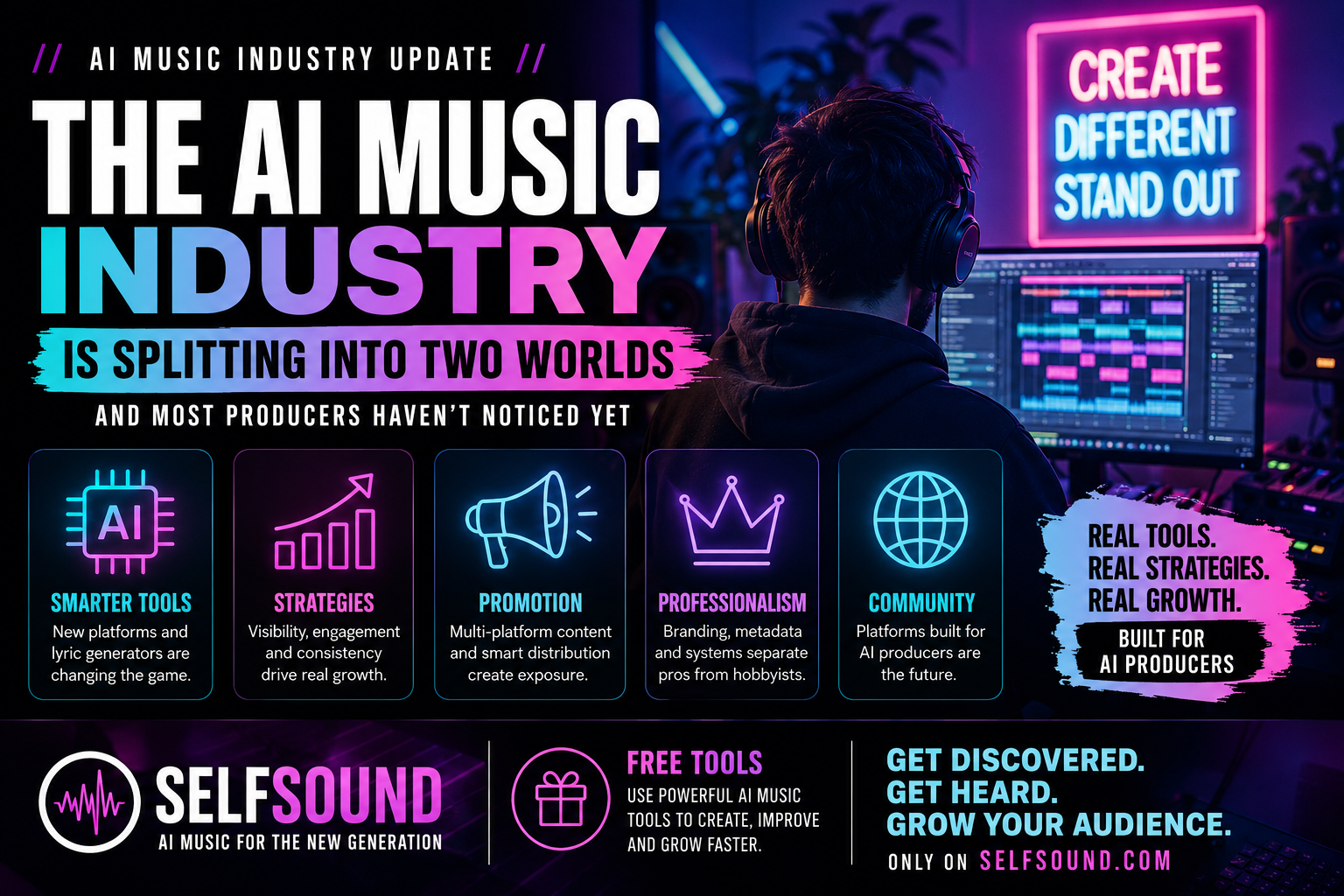
A major shift is happening across the AI music industry right now, and most creators are still looking in the wrong direction. The conversation is no longer just about generating songs faster. The real competition has moved toward identity, originality, and workflow control.
In the early wave of AI music, creators were impressed by the ability to generate complete songs in seconds. That novelty phase is ending. Audiences have already heard thousands of generic AI tracks. What they respond to now is recognisable artistic direction. Producers who understand this are separating themselves from creators who still rely entirely on random prompts and automated outputs.
The newest generation of AI music platforms is adapting to this demand. Udio has been attracting producers who want more emotional continuity and cinematic structure in their tracks, while Suno continues dominating rapid concept generation and commercial-ready vocal production. What is changing, however, is how producers use these tools. The strongest creators are no longer generating one-off songs. They are building repeatable sonic identities using AI as a production assistant rather than a replacement artist.
The same evolution is happening inside AI lyric generation. The market has become crowded with lyric tools, but not all of them solve the same problem. Some focus on speed, while others focus on emotional realism or structure refinement.
LyricStudio has gained popularity among producers who struggle with unfinished songs because its collaborative structure helps creators continue writing without losing momentum. ChatGPT remains one of the most flexible lyric systems because producers can shape narrative tone, rhyme density, vocal cadence, and emotional themes with precision. Jasper AI is increasingly being used for artists building character-driven music brands because it can maintain consistent voice styles across multiple releases. Meanwhile, Writesonic is heavily used by short-form content creators producing viral hooks for TikTok and Instagram audio campaigns.
Writer’s block is still one of the biggest reasons producers abandon projects halfway through, but the solution has changed. The old advice was to “wait for inspiration.” Modern AI producers are doing the opposite. They are building systems instead of waiting for moods.
Many successful creators now begin with visual concepts before lyrics even exist. They use imagined scenes, fake movie plots, emotional conflicts, or social media trends to generate direction first. Once the atmosphere is clear, the lyrics become easier to shape. This is why AI video creators are moving into music creation so aggressively. They already understand visual storytelling, emotional pacing, and audience psychology.
Platforms like Runway and Pika are indirectly influencing music production because creators are designing songs around visual experiences rather than radio formulas. Music is becoming more connected to content ecosystems instead of existing alone.
Many AI producers are still making a critical mistake. They believe the best song automatically wins. That is not how the current market works.
Visibility wins first. Reputation wins second. Music quality only starts mattering once people are paying attention consistently.
The creators growing fastest right now understand platform behaviour better than most musicians. They know attention is built through repetition. Audiences trust creators they recognise regularly, not creators who disappear for months between uploads.
One strategy working extremely well is documenting progression publicly instead of only posting finished releases. Producers showing failed experiments, beat variations, lyric rewrites, AI workflow tests, and unfinished concepts are building stronger communities because audiences feel involved in the creative process.
Another strategy gaining momentum is identity-based branding. Instead of trying to make every genre possible, smart AI producers are narrowing their sound aggressively. Audiences remember creators with a distinct emotional atmosphere far more easily than creators constantly changing styles.
There is also a major rise in “micro-audience producers.” These are creators intentionally building smaller but highly loyal fanbases around niche aesthetics like dystopian synthwave, AI jazz fusion, cinematic trap orchestration, virtual idol music, or dark ambient storytelling. These producers often outperform broader creators in engagement because their audiences feel culturally connected rather than casually entertained.
AI video creators entering music production already understand this deeply. They know audience retention depends on emotional consistency and recognisable style. That advantage translates directly into AI music growth.
The most effective producers today are not behaving like musicians alone. They are operating like media brands.
The AI music market is becoming brutally competitive because the barrier to entry has almost disappeared. That creates freedom, but it also creates noise.
A massive percentage of AI-generated music receives almost no engagement because creators misunderstand exposure completely. Uploading tracks to streaming platforms without active promotion is the digital equivalent of releasing music into empty space.
The producers gaining traction are distributing attention strategically. They are clipping tracks into short-form content, uploading alternate versions, creating reaction-style edits, building Discord communities, participating in creator conversations, and maintaining activity even when songs are not performing immediately.
Promotion in 2026 is heavily tied to multi-platform movement. Producers using CapCut for rapid content creation, Canva for visual branding, and Metricool for performance tracking are operating far more effectively than creators relying purely on uploads.
Playlist strategy is also evolving. Independent AI producers are finding more traction through niche playlists, AI-themed communities, gaming audiences, and cinematic content creators rather than chasing giant editorial placements immediately.
Another uncomfortable truth is that many producers quit too early. They interpret low numbers as rejection when most successful creators initially experienced the same invisibility period. Growth in AI music is usually delayed because algorithms need behavioural data before increasing exposure.
The market rewards creators who remain active long enough to become familiar.
Professionalism has become one of the strongest separating factors in AI music because audiences now instantly recognise disorganised creators.
Real producers think beyond individual songs. They think in systems.
Metadata is part of discoverability strategy. Branding is part of audience memory. Consistent artwork builds recognition. Release timing influences algorithmic behaviour. File organisation affects productivity. These details matter because serious creators understand that professionalism compounds over time.
The producers building long-term growth are maintaining organised release calendars, structured branding assets, and consistent presentation across every platform they use.
Even communication style matters now. Artists who respond professionally, maintain clean profiles, and communicate clearly with audiences appear more trustworthy and established immediately.
The creators treating AI music casually are slowly disappearing beneath creators operating with structure and discipline.
Selfsound.com is continuing to grow as a platform focused directly on AI music creators instead of treating AI content like an afterthought.
That distinction matters because AI producers need spaces designed around modern creation workflows rather than outdated music platform models. Selfsound.com is positioning itself as a place where AI creators can actually gain visibility, connect with active listeners, and access genuinely useful free tools built for the AI music space.
The platform is also becoming increasingly relevant for creators searching for real engagement instead of artificial metrics. Discovery only matters if listeners are actively interested in AI-generated music culture, and that audience is growing rapidly.
As more creators enter the market, specialised AI music platforms are becoming increasingly important because they allow producers to stand out inside focused communities rather than being buried inside oversaturated mainstream systems.
Selfsound.com is building toward that future.
AI music is creating one of the fastest creative shifts the music industry has seen in decades, but opportunity alone does not create careers.
The creators who succeed from this moment forward will be the ones willing to adapt faster than everyone else. Not just creatively, but mentally.
The industry is moving away from simple experimentation and toward long-term creator positioning. Producers who understand branding, consistency, emotional storytelling, audience behaviour, and platform strategy are building advantages that casual creators will struggle to catch later.
Most people will stop when growth feels slow. Most people will disappear once trends change. Most people will become inconsistent the moment attention drops.
The creators who stay active anyway are usually the ones who eventually break through.
AI tools can generate music quickly, but they cannot replace discipline, identity, patience, or strategic thinking. Those traits still belong entirely to the creator behind the screen.