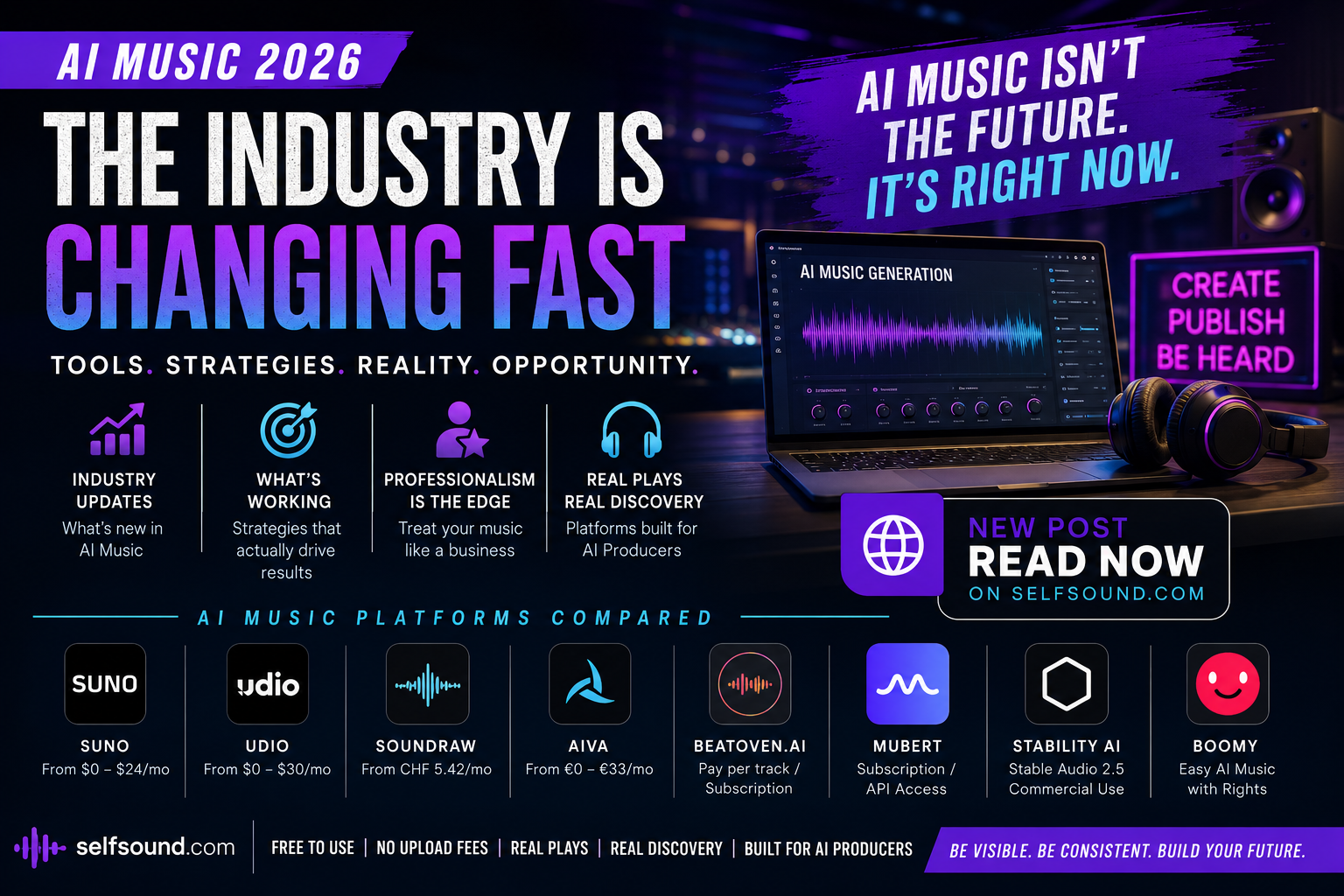
The AI music market is no longer operating like an experiment. It is turning into a rights driven business where licensing, distribution control, detection, and creator monetization matter more than hype. In 2026, Reuters reported that Warner settled its lawsuits with Suno and agreed to launch joint music creation platforms, while AP reported that Universal settled with Udio and that Udio stopped offering downloads of AI generated songs as part of the new arrangement. Reuters also reported that Deezer said it removed up to 85% of fraudulent AI generated streams from its royalty pool in 2025 and was receiving around 60,000 fully AI created tracks every day. That is the real signal. The market is moving from novelty into infrastructure.
The pricing model tells the same story. Suno currently offers a free plan at $0, a Pro plan at $8 per month, and a Premier plan at $24 per month, with commercial use and stem tools reserved for paid tiers. Udio’s free accounts get 10 daily credits plus 100 monthly credits, Standard is $10 per month, and Pro is $30 per month, with trials limited to a seven day window and no Pro trial available. SOUNDRAW has moved into a creator and artist ladder, with Creator at CHF5.42 per month, Artist Starter at CHF9.58 per month, Artist Pro at CHF11.25 per month, and Artist Unlimited at CHF15.83 per month, while the higher tiers unlock wav and stems. AIVA still keeps a free tier at €0, Standard at €11 per month billed annually, and Pro at €33 per month billed annually, with Pro giving the creator full copyright ownership. Beatoven.ai is leaning into monetizable, pay per track or subscription workflows, Mubert is selling subscription, perpetual license, and API access routes, Stability AI is positioning Stable Audio 2.5 around licensed datasets and commercial use, and Boomy continues to market itself as an easy generative music option with commercial rights. The pattern is obvious. Serious platforms are charging for rights, output control, and professional use, not just prompts.
What is working right now is simple, and most people still do not want to hear it. Engagement matters first. Comments, likes, reposts, saves, and repeat listens are not vanity metrics when the whole category is crowded with fast uploads. They are proof that a track connected with somebody. Producers who understand this stop thinking like people who just generate songs and start thinking like creators who build momentum. On Selfsound, the platform’s own weekly coverage emphasizes real play tracking, community comments, and discovery, which is exactly the kind of environment that rewards visible activity instead of silent output.
The producers getting traction are also building reputation before they obsess over plays. They are releasing often, watching what the audience reacts to, studying other producers, and refining their presentation with every upload. That is not theory. Selfsound’s recent coverage explicitly describes successful creators as the ones monitoring analytics, testing audience response, improving their presentation, and building systems instead of waiting for inspiration. That is the playbook now. Consistency beats talent when talent is inconsistent. Presence beats perfection when the market is moving this fast.
Not everyone will make it, and that is not pessimism. That is math. The barrier to creating a track is low now, which means the barrier to standing out is higher. Most producers are still treating AI music like a shortcut when the market is treating it like a business. The ones winning are active, visible, and strategic. They are not waiting to be discovered. They are earning attention through repetition, quality control, and a recognizable identity.
Most producers are also not doing the real work. They are generating files, posting once, and calling it a brand. That is not enough anymore. The market does not reward passive uploads, and it definitely does not reward excuses. If you are not building a catalog, a recognizable style, and a consistent public presence, you are not competing. You are just participating.
Professionalism is no longer optional. It is the edge. Real producers understand metadata, branding, release cadence, and business discipline because those things separate a hobby file from a release that can actually travel. A clean track name, correct credits, structured file data, and consistent visual identity matter because they signal seriousness before anyone even hears the song.
This is also where licensing awareness becomes non negotiable. Mubert’s pricing and licensing page makes it clear that its tracks are not licensed for Content ID, standalone release on streaming platforms, or stock music sites, which is exactly why producers have to read the fine print before they release anything commercially. Selfsound’s Audio Cleaner even includes metadata removal as a built in function, which shows how operational this world has become. The takeaway is blunt. If you treat music like content, the market will treat it like content. If you treat it like a business, you give yourself a real chance to build one.
Selfsound.com is positioning itself as a dedicated platform for AI music producers and digital creators, not a generic upload site. The platform says it is free to use with no upload fees and no hidden costs, and it describes itself as an AI only environment built for AI generated music and AI assisted productions. It also says every upload receives a certified timestamp, giving creators a record tied to their account and upload, which is a practical benefit for anyone who takes ownership seriously. That matters because AI creators do not just need a place to post music. They need a place that understands what they are building.
Selfsound is also building around actual discovery. Its homepage features Top 5 Tracks of the Week, real play counts, comments, and creator visibility, while its weekly AI music coverage repeatedly emphasizes free tools for AI producers, real plays, audience alignment, and a discovery focused ecosystem. The platform’s Audio Cleaner gives creators a direct workflow tool for removing hiss, cleaning metadata, and preparing tracks for release. That combination is important. Free tools available for AI producers on Selfsound.com, a place for real plays, a place to get discovered, and a platform built for AI producers is exactly the kind of positioning the market is starting to reward.
This is still early enough to build, but it is no longer early enough to be casual. The easy phase is ending. The people who move now will have the advantage of compounding presence, cleaner branding, and stronger audience memory before the space gets even more crowded. The major labels are already moving from conflict to licensing and partnerships, which is a sign that AI music is becoming a real commercial category instead of a temporary trend.
So stay visible. Release consistently. Study what is getting attention. Improve your presentation. Treat every upload like part of a larger catalogue, not a random experiment. The winners in AI music will not be the loudest people in the room. They will be the ones who keep showing up, keep learning, and keep operating like the industry is already serious, because it is.