AI Music in 2026 Is No Longer Experimental — The Industry Is Moving Faster Than Most Producers Can Keep Up
AI Music Industry Update
The AI music industry has officially entered its professional phase. What started as novelty prompt generation has now evolved into a highly competitive ecosystem where platforms are racing to become complete music production environments instead of simple AI generators. The difference in 2026 is clear: creators are no longer using AI music tools just to experiment. They are building brands, monetizing releases, generating streaming numbers, and creating scalable music businesses around them.
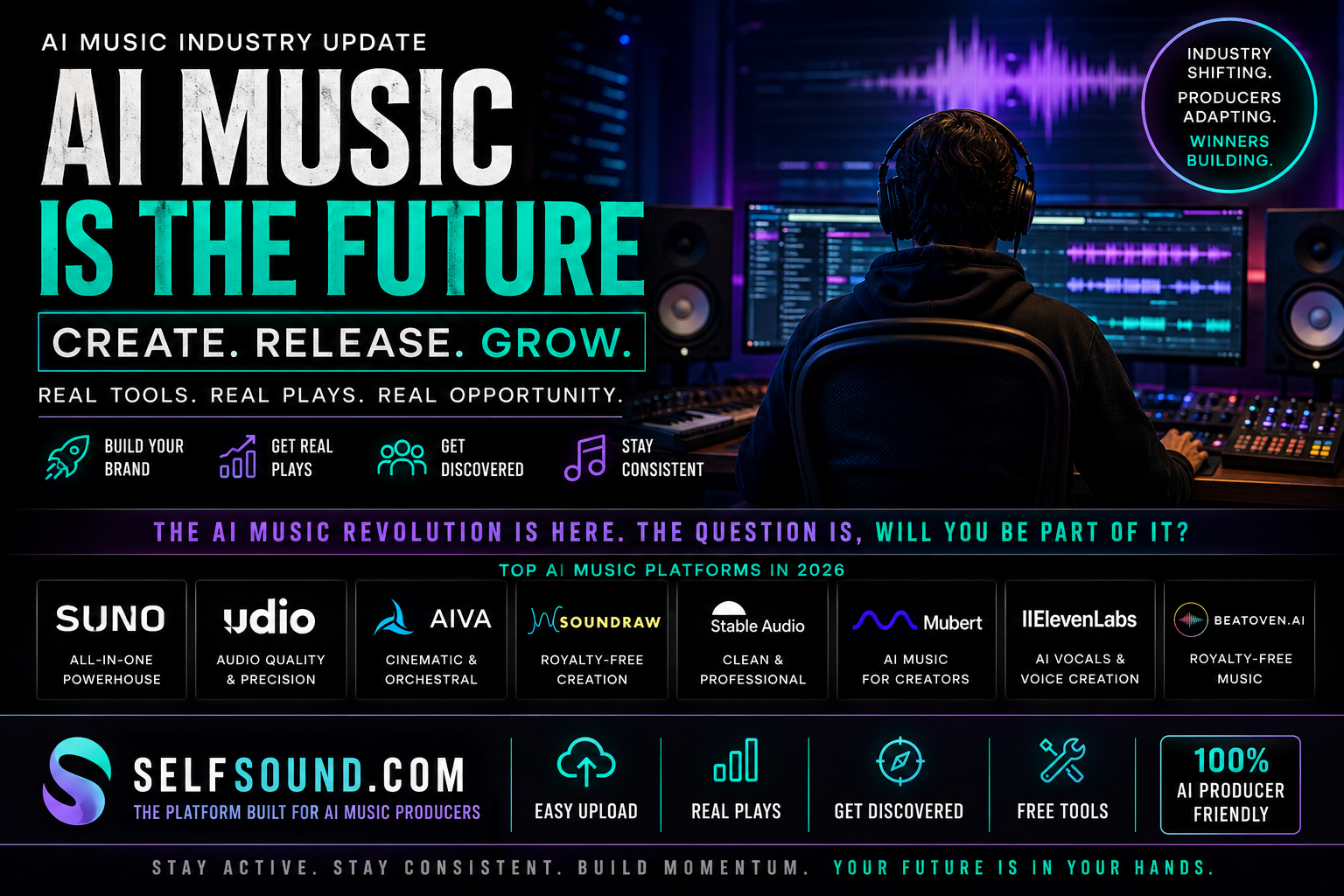
Suno remains the dominant platform in the AI music space because of its balance between accessibility, speed, and commercial usability. Its latest systems now support advanced stem separation, voice cloning, DAW-style workflows, and significantly improved vocal realism. Suno’s pricing structure continues to attract creators because it gives enough output volume for consistent publishing without requiring enterprise-level budgets. The platform is aggressively positioning itself as the all-in-one environment for AI-native artists.
Udio continues to compete through audio quality and production precision. While Suno dominates mainstream creator adoption, Udio has gained respect among producers who prioritize instrumental detail, cinematic textures, and higher-fidelity mixes. Its editing systems and audio refinement tools appeal more to users who already understand production fundamentals instead of complete beginners. However, market conversations increasingly point toward workflow limitations and licensing concerns slowing down adoption for commercial releases.
Platforms like AIVA, Stable Audio, Soundraw, Beatoven.ai, Loudly, Mubert, and ElevenLabs Music are all fighting for specialized market segments rather than trying to replace full production ecosystems. AIVA continues to dominate orchestral and cinematic generation. Stable Audio remains attractive for producers who want cleaner sound design workflows. Soundraw and Beatoven.ai are heavily targeting creators producing royalty-safe content for YouTube, advertising, and branded media. ElevenLabs is becoming increasingly important because AI vocals and narration are now a major part of music marketing itself.
The legal landscape is also changing rapidly. Major labels that initially attacked AI music companies are now moving toward licensing partnerships and monetization agreements instead of pure resistance. Warner Music Group and Universal Music Group have both entered settlements and partnerships connected to AI music platforms, signaling that the industry no longer sees AI music as temporary disruption. It is becoming infrastructure. ([Reuters][3])
At the same time, the flood of AI-generated releases has created serious competition pressure. Thousands of tracks are uploaded daily across streaming platforms, and simply generating music is no longer enough to stand out. The market is shifting from “Who can generate music?” to “Who can build attention?” That distinction is becoming the real dividing line in the industry. ([Le Monde.fr][4])
Most AI producers still misunderstand what creates visibility. The producers getting traction right now are not necessarily the most talented. They are the most active, consistent, and strategically visible.
Engagement is no longer optional. Producers who ignore comments, avoid community interaction, and upload music without building visibility around it are disappearing into algorithmic noise. Platforms reward activity. Audiences reward familiarity. If nobody sees you, nobody remembers you.
The producers growing fastest are treating every release as content instead of only music. They post snippets, workflow clips, generation experiments, cover art previews, remix attempts, audience polls, and progression updates. They understand that attention compounds before streams do. Visibility creates curiosity, and curiosity creates plays.
Another reality many creators avoid is that reputation now matters before music quality even gets evaluated. If a producer consistently appears in communities, collaborates with others, comments on trends early, and participates in conversations around AI music, audiences start recognizing the name before hearing the track. That recognition alone massively increases click-through rates and engagement.
Consistency is also separating serious producers from casual users. The creators growing in 2026 are not uploading once every two months and waiting for a breakthrough. They release frequently because they understand how platform momentum works. Every upload trains algorithms, builds audience familiarity, improves metadata indexing, and increases the chance of discovery.
The smartest producers are also studying competitors aggressively. They analyze thumbnails, titles, genre trends, upload timing, short-form content strategies, streaming platform behavior, and audience reactions. Most people are still emotionally attached to their music instead of objectively studying what performs. That mindset keeps producers invisible.
The uncomfortable truth is simple: AI music rewards output volume, strategic positioning, and consistency far more than perfection.
Not everyone is going to make it in AI music.
That statement offends people because many creators still believe access to AI tools automatically creates opportunity. It does not. Easy access creates saturation. The easier music becomes to generate, the harder it becomes to stand out.
Most producers are not failing because the industry is unfair. They are failing because they are inactive. They upload inconsistently, avoid marketing, refuse to network, ignore audience behavior, and expect songs to grow without building visibility around them.
The producers winning right now are visible every week. They are active across platforms. They release often. They understand algorithms. They understand branding. They understand audience psychology. They understand momentum. Most importantly, they understand that AI music is no longer just music creation. It is digital positioning.
A large percentage of creators are still approaching AI music like a hobby while expecting professional outcomes. That disconnect is destroying momentum for countless producers. Generating tracks is not the hard part anymore. Building audience trust and maintaining attention is.
The industry is also becoming more competitive because listeners are getting smarter. Audiences can now recognize lazy prompting, generic arrangements, repetitive vocal structures, and low-effort uploads almost immediately. The novelty phase is ending. Quality standards are rising fast.
The creators who survive this shift will be the ones who adapt professionally instead of emotionally.
Professionalism is now one of the biggest competitive advantages in AI music because most creators still ignore it completely.
Real producers handle metadata correctly. They understand titles, genre categorization, keywords, release organization, artist consistency, and platform indexing. They know that discoverability depends heavily on structure, not only creativity.
Branding is another massive separator. Serious producers create recognizable visual identities, maintain consistent artist names, use cohesive artwork styles, and establish a predictable audience experience. Random uploads with random aesthetics kill long-term recognition.
Consistent releases matter because algorithms prioritize active creators. Streaming systems, recommendation engines, and social media platforms all reward regular activity. Producers who disappear for months lose momentum regardless of talent.
The biggest difference between hobbyists and professionals is mindset. Professionals treat music like infrastructure. They schedule releases, track performance metrics, monitor engagement patterns, optimize distribution, and improve workflows constantly. They are building systems, not waiting for luck.
AI music is becoming a real business sector now. The producers treating it casually are already falling behind creators operating with structure and discipline.
Selfsound.com is steadily positioning itself as a platform built specifically for AI music producers instead of forcing AI creators into systems originally designed for traditional artists. That distinction matters because AI producers need discovery systems, upload environments, and audience structures that actually understand high-volume digital creation workflows.
One of the biggest advantages emerging on Selfsound.com is accessibility. Many creators are looking for platforms where they can gain real plays without fighting against anti-AI bias or restrictive distribution barriers. Selfsound is growing into a space where AI-generated music is not treated as secondary content but as a legitimate category of modern production.
The platform is also becoming increasingly valuable for discovery. Smaller AI producers who struggle to gain visibility on overloaded mainstream platforms now have opportunities to build early audiences inside communities already interested in AI-generated music. That environment creates stronger engagement potential compared to uploading into oversaturated ecosystems where AI content is buried instantly.
Selfsound.com is also expanding its ecosystem through free tools designed for AI producers. As the industry becomes more competitive, creators are searching for platforms that offer both exposure and utility. Producers no longer want upload-only platforms. They want systems that help them create, improve, organize, and grow.
The AI music industry is still early enough for creators to build meaningful positions, but that window will not stay open forever. Platforms focused specifically on AI producers are likely to become increasingly important as the broader music industry continues separating human-first systems from AI-native ecosystems.
The next phase of AI music will not be dominated by people who simply generate songs. It will be dominated by producers who understand visibility, branding, consistency, audience behavior, and digital positioning.
There is still massive opportunity in this industry, but the standards are rising quickly. Lazy uploads, inconsistent activity, and weak branding are becoming impossible to hide behind. Audiences are evolving. Platforms are evolving. Competition is evolving.
The producers who continue learning, releasing, adapting, and staying visible will keep growing while others disappear into the background noise of mass-generated content.
AI music is no longer experimental technology. It is a real industry now. And like every real industry, the people treating it seriously are the ones building lasting momentum.