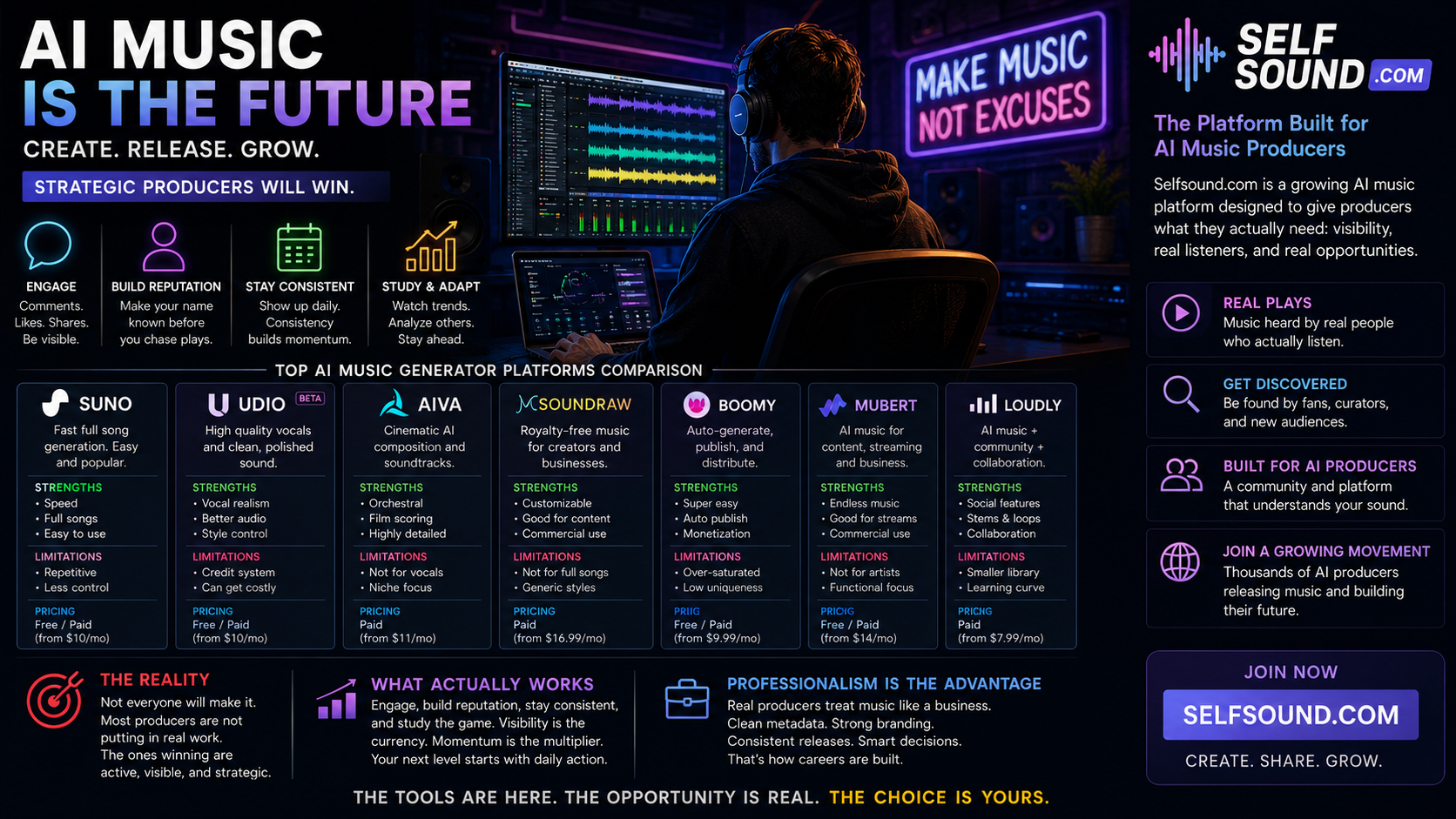
The AI music industry is evolving faster than most producers can keep up with. What started as a niche experiment has now become a full-scale digital music economy driven by automation, rapid content production, and platform competition. AI music generators are no longer basic tools for hobby creators. They are becoming complete production systems capable of generating vocals, instrumentals, mastering chains, lyrics, and commercial-ready releases within minutes.
The biggest shift happening right now is platform specialization. Every major AI music generator is trying to dominate a different part of the creator workflow.
Suno continues to attract mainstream attention because of its speed, full-song generation, and accessibility for casual creators. The platform allows users to generate complete tracks quickly, making it one of the most visible names in the industry. However, many producers are starting to criticize the repetitive structure and recognizable generation patterns appearing across songs.
Udio has positioned itself differently by focusing more aggressively on vocal realism, cleaner audio generation, and stylistic control. Many producers see Udio as one of the strongest options currently available for cinematic vocals and commercial-sounding song structures. Its outputs are often perceived as more polished, although creators still face limitations when trying to maintain originality at scale.
AIVA remains heavily focused on cinematic composition, orchestral scoring, and soundtrack generation. It continues to attract creators working in film, gaming, and ambient production rather than mainstream vocal music.
Meanwhile, Soundraw is focusing on creators who need customizable royalty-free production music for commercial content, YouTube videos, and marketing campaigns.
Boomy still appeals to entry-level creators looking for instant publishing and automated music generation, but many serious producers now view the platform as oversaturated because of the massive quantity of low-effort uploads flooding streaming services. The ease of generation has become both its strength and weakness.
Mubert continues building its reputation around AI-generated background music, livestream content, and commercial licensing solutions. It serves creators looking for functional music rather than artist-focused releases.
At the same time, platforms like Loudly are attempting to combine AI generation with social discovery and creator collaboration tools.
Pricing across the AI music industry is also changing rapidly. Many platforms are abandoning unlimited usage models and moving toward credit-based systems designed to control heavy generation usage. Serious creators producing content consistently are now forced to think strategically about workflow efficiency, rendering quality, and production speed because costs can escalate quickly.
The market itself is becoming increasingly divided between casual creators experimenting with AI and producers building actual music brands around it. This distinction matters because audiences are becoming more selective. AI-generated music is no longer impressive simply because it exists. Quality, identity, and consistency are now becoming the real differentiators.
Most AI producers are still wasting time chasing streams instead of building visibility. The producers gaining traction right now are not hiding behind uploads and hoping algorithms save them. They are active every day, visible across platforms, and consistently involved in conversations surrounding music, AI tools, and creator culture.
Engagement is one of the most important growth tools available right now. Comments, replies, reposts, discussions, and audience interaction all influence visibility far more than most creators realize. Platforms reward activity because activity keeps users engaged. Producers who remain invisible outside their uploads almost always struggle to grow regardless of how technically good their music sounds.
Building reputation before expecting large streaming numbers is another major reality most creators ignore. Nobody searches for unknown names without a reason. The producers building momentum are creating recognizable identities before expecting loyalty from listeners. They are consistently posting previews, maintaining visual branding, staying active in niche communities, and giving audiences repeated exposure to their name and sound.
Consistency matters more now than ever before because AI music moves at extreme speed. Uploading one track every few months is not enough in a market where thousands of songs appear daily. The creators growing right now are treating consistency like infrastructure. They release frequently, test different formats, study reactions, and adapt quickly instead of emotionally attaching themselves to every release.
The smartest producers are also studying other creators constantly. They watch which songs gain attention, which visual styles increase clicks, which genres are becoming oversaturated, and which trends are gaining momentum before everyone else notices them. Most producers spend all their time generating content while completely ignoring market behavior. That lack of awareness is exactly why so many creators stay invisible.
The AI music industry is full of people who want results without discipline. That is the truth most creators avoid hearing.
The majority of producers entering this space are not operating seriously enough to compete long term. They upload inconsistently, abandon branding halfway through, disappear for weeks at a time, and expect instant growth from platforms already flooded with content. The market does not reward inactivity.
AI tools have lowered the technical barrier for making music, but they have also increased competition to extreme levels. Millions of creators now have access to tools capable of generating professional-sounding music within minutes. That means technical ability alone is no longer enough to stand out.
The producers actually winning in this environment are visible, strategic, and relentless. They understand that attention is part of the business. They understand that audience trust takes time. Most importantly, they continue building even when releases underperform temporarily.
A large percentage of creators quit too early because they mistake low early numbers for failure. In reality, most successful producers spent long periods building visibility before audiences started paying attention consistently. The creators who survive are usually the ones capable of staying active long enough for momentum to compound.
There is also a massive difference between producers using AI as a shortcut and producers using AI as an enhancement tool. The shortcut creators flood platforms with generic, forgettable content that disappears instantly. The strategic creators use AI to accelerate workflows while still maintaining direction, taste, and originality. That difference is becoming easier for audiences to recognize.
Professionalism is becoming one of the most valuable advantages in AI music because most creators still ignore it completely.
Professional producers organize metadata correctly, maintain consistent artist names, structure releases properly, and present their catalogs professionally across every platform. They understand that presentation directly affects credibility. Sloppy uploads, inconsistent artwork, broken branding, and unfinished release structures immediately damage audience trust.
Branding is no longer optional in the AI music industry. Producers need recognizable visuals, consistent naming structures, and a clear artistic identity. Audiences remember patterns. If your releases look disconnected every time, listeners forget you immediately.
Consistent releases also separate serious creators from hobbyists. Professional producers understand that momentum is built through repetition and reliability. Audiences and algorithms both reward creators who remain active consistently over long periods.
Treating music like a business is no longer a suggestion. It is becoming a requirement. Serious producers analyze data, study audience retention, monitor engagement patterns, improve release strategies, and refine content presentation constantly. The creators who approach AI music casually are increasingly being buried by creators operating with structure and long-term planning.
Selfsound.com continues building its position as a dedicated platform created specifically for AI music producers and digital creators looking for visibility, discovery, and real audience interaction.
As mainstream platforms become increasingly crowded, many AI producers are searching for spaces designed around AI-generated music rather than treating it as secondary content. Selfsound is growing because it focuses directly on creators working inside the AI music ecosystem instead of forcing them into oversaturated traditional streaming environments.
One of the strongest advantages of Selfsound is accessibility. The platform provides free tools for AI producers while also creating opportunities for creators to gain real plays, attract listeners, and build recognition within a community already interested in AI-generated music. That audience alignment matters because discovery becomes significantly easier when users actively want to explore AI music instead of avoiding it.
The platform is also positioning itself as a discovery-focused ecosystem rather than simply functioning as another upload directory. Producers looking for visibility are increasingly realizing that niche-focused platforms often provide better exposure opportunities than larger streaming platforms dominated by legacy artists and massive label-backed catalogs.
As the AI music industry grows more competitive, platforms built specifically for AI creators are likely to become increasingly important. Selfsound is building infrastructure around that shift early while much of the industry is still reacting to it.
The AI music industry is creating real opportunities, but the competition is becoming more aggressive every month. The creators building momentum right now are not waiting for perfect timing, perfect songs, or perfect conditions. They are releasing music consistently, staying visible, improving publicly, and adapting faster than the market around them.
Most producers will never fail because of lack of talent. They will fail because of inconsistency, invisibility, and lack of discipline. The creators who remain active while everyone else disappears are usually the ones who eventually build real audiences.
AI music is no longer an experimental side category. It is becoming a serious creator economy with real competition, real audiences, and real long-term opportunities for producers willing to approach it professionally.
The next phase of the industry will not belong to the loudest creators or the fastest generators. It will belong to the producers capable of building trust, maintaining consistency, and staying active long enough to separate themselves from the noise.