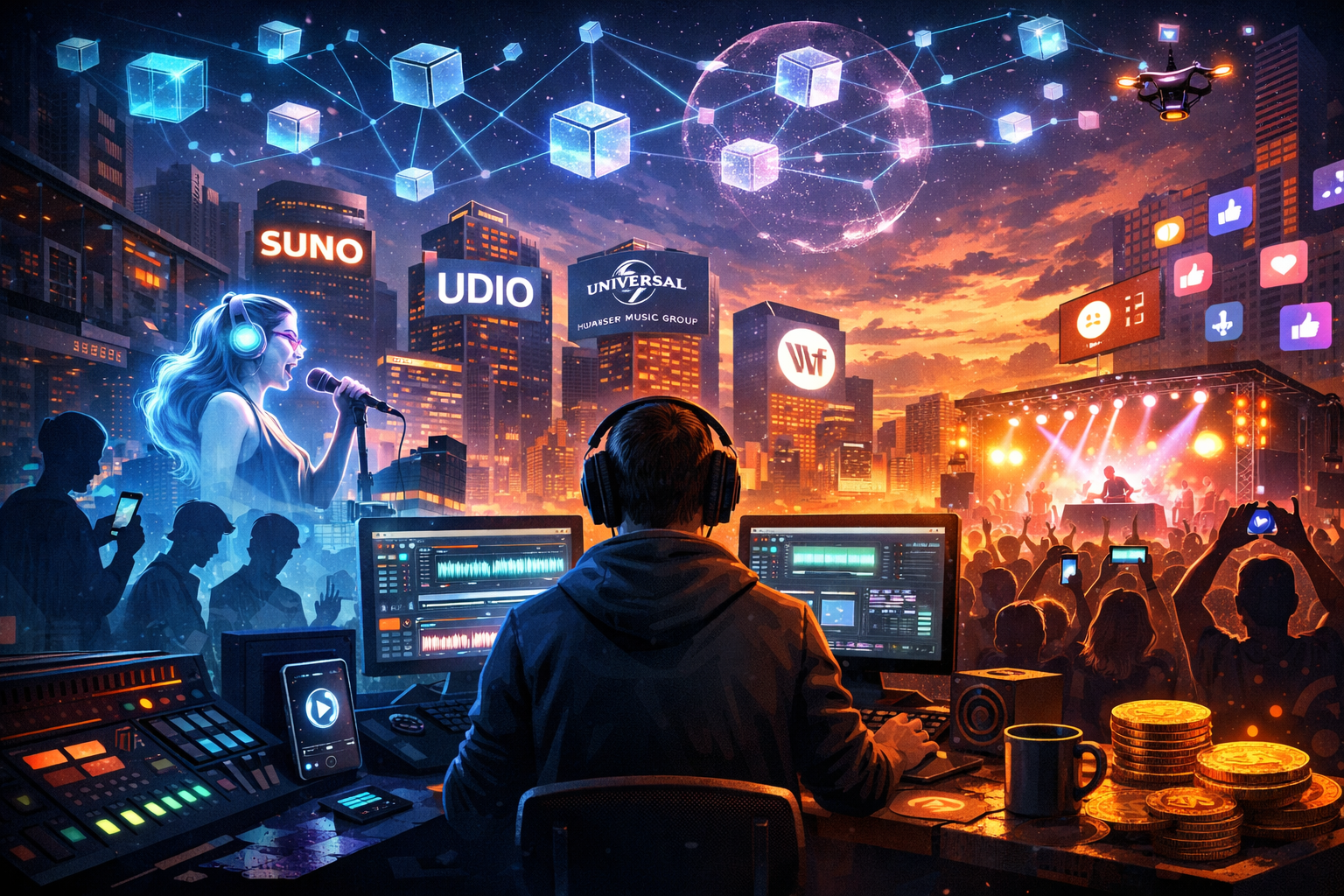
The AI music industry is no longer experimental. It is now a real economy, a real market, and a real battle for attention. The barrier to entry is almost gone, which means almost anyone can now make music. The problem is that almost nobody is getting noticed.
Right now, the biggest shift in AI music is control versus exposure.
The major generator platforms are controlling music creation. Large music companies are still trying to position themselves around licensing, ownership, and influence. Distribution platforms still control visibility. That means the average producer can make more music than ever before, but still struggle to build a real audience.
If you are simply generating songs and uploading them without a plan, you are already behind.
The producers are not the ones running this industry right now.
The real control is sitting with the AI tool companies, the major music businesses, and the platforms that control distribution and discovery. They control access, they control visibility, and they control how much attention a track gets.
But there is still one area that is open.
Attention itself is still up for grabs.
That is where producers still have a chance. No one fully owns public attention yet. If you know how to market yourself properly, you can still break through.
One of the biggest changes happening now is saturation. There is more AI music being uploaded every day than most users can ever listen to. That means quantity alone is no longer enough. Just making more songs is not a strategy anymore.
Another major shift is identity. Users are starting to pay more attention to producers, names, styles, and personalities rather than just random tracks. If your name means nothing and your profile looks dead, your music becomes easier to ignore.
There is also a growing movement toward decentralized ownership, onchain identity, and independent distribution. More producers are beginning to understand that real control will come from owning their own audience, their own presentation, and their own content systems instead of relying only on centralized platforms.
At the same time, pricing models are changing. Many AI music tools are pushing further into credits, generation limits, token systems, and tiered access. That means the easy and cheap era will not stay the same forever. Producers should prepare now for a market where creation becomes more controlled and more expensive.
The biggest mistake in AI music right now is thinking that making music is enough.
It is not.
Marketing is the real game. The song is the product, but the producer is the brand.
Most producers post tracks and then vanish. They do not engage. They do not comment. They do not support others. They do not ask questions. They do not become visible. Then they wonder why nobody is checking for them.
That is the wrong approach.
People follow names they keep seeing. They follow users who appear active, involved, and recognizable. Familiarity matters more than most people want to admit.
The smartest producers right now are not just uploading songs. They are building a presence.
Start by being visible in the places where your niche already gathers. Comment on songs. Give feedback. Ask real questions. Support other users publicly. Show up consistently. Let your name become familiar.
When people keep seeing your name, they begin to remember it. When they remember it, they start clicking it. When they start clicking it, you have a real chance to build a following.
Another smart move is to build up a track before release. Talk about the release in advance. Mention the style. Mention why you made it. Mention the theme or goal. Create anticipation instead of just dropping a link and hoping for magic.
You should also pay attention to what other users respond to. Watch which songs get comments. Watch which styles get replayed. Watch which titles, visuals, or themes pull attention. The market leaves clues. Good marketers study them.
A lot of AI music groups look supportive on the surface, but many of them are cold, crowded, and full of people only promoting themselves.
That is the truth.
A lot of producers do not really listen to other producers. They post their own work and move on. They want engagement, but do not give it back. That creates a bad cycle where everyone is speaking and nobody is listening.
So stop expecting every music group to be your growth engine.
Use groups for visibility, for testing reactions, and for making your name familiar, but do not rely on them for loyalty. Many of them are not built for real support.
This is one of the biggest opportunities in the industry right now.
Too many producers spend all their time trying to impress other producers. That is not where the growth is.
Real listeners matter more.
Look for users who may not make music at all, but enjoy hearing it, sharing it, replaying it, and following artists they connect with. Those are the people who help build a real audience. Those are the users who can actually move your work forward.
If someone genuinely listens, their support is worth more than ten producers who only came to drop their own links.
Follow producers and creators who are active, visible, and smart about branding. Follow the people who actually engage with communities. Follow the ones experimenting with new systems, new distribution methods, and new ways to present music. Follow those who are building a real identity, not just uploading random tracks.
Avoid fake engagement circles, dead groups, and users who promise instant success. Avoid anyone who acts like the music alone will do all the work. Avoid systems that make you dependent on their platform while giving you little real ownership in return.
A serious producer should always be asking one question.
Am I building something I control, or am I building value for someone else’s platform?
Most producers still do not fully understand how exposed they are.
If your audience, content, and visibility all depend on one company, one generator, or one platform, then you do not really control your music career. Rules can change. Access can change. Pricing can change. Reach can disappear.
Another warning is oversaturation. Low effort music is going to get buried harder and harder. The more content floods the market, the more important identity, presentation, and strategy become.
The producers who survive this shift will not just be the ones making songs. They will be the ones building a clear identity, a recognizable name, and a smart system around their work.
Focus on visibility first.
Focus on identity second.
Focus on consistency third.
Build a name people keep seeing. Build a style people start recognizing. Engage more than you post. Learn how to launch a track instead of just uploading it. Study what gets reactions. Pay attention to real listeners. Build where possible in ways that give you more control over your content, your image, and your audience.
The producers who win in this market will not always be the most talented.
They will be the most visible, the most strategic, and the most consistent.
AI music is moving fast, but the real opportunity is still here for producers who understand what is happening.
The market is crowded. The platforms are getting stronger. The industry is getting more competitive. Social groups are often weak. Support is often fake. But attention is still available to the producers who know how to earn it.
Do not just make music.
Build your name.
Build your presence.
Build your audience.
That is what serious producers should be focused on now.